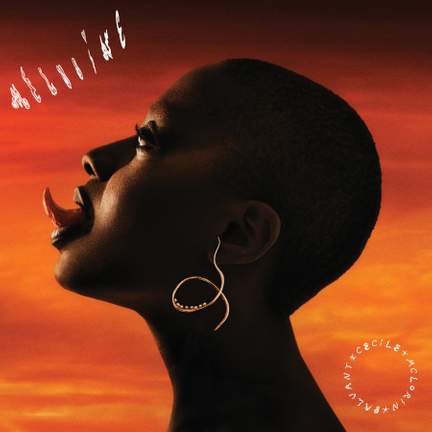
Mélusine
Cécile McLorin Salvant
Awards:
-
Jazzwise, Editor's Choice, April 2023

-
Presto Recordings of the Year, Winner 2023

Anyone who thinks they know the full extent of Cécile McLorin Salvant's artistry should listen to Mélusine without delay.
Mélusine
Cécile McLorin Salvant
Purchase product
Other available formats

Awards:
-
Jazzwise, Editor's Choice, April 2023
-
Presto Recordings of the Year, Winner 2023
Anyone who thinks they know the full extent of Cécile McLorin Salvant's artistry should listen to Mélusine without delay.
About
Mélusine features a mix of five originals and interpretations of nine songs, dating as far back as the twelfth century, mostly sung in French along with Occitan, English, and Haitian Kreyol.
The new album’s songs tell the story of the European folkloric legend of Mélusine, a woman who turns into a half-snake each Saturday as a result of a childhood curse by her mother. Mélusine later agrees to marry Raymondin on the condition that he never see her on Saturdays. He agrees but is ultimately convinced by his brother to break his promise, piercing his wife’s door with his sword and finding her naked in the bath, half snake, half woman. When she catches him spying on her, she turns into a dragon and flies out the window, only to reappear every time one of her descendants is on their deathbed.
“I think what I try to do is more akin to revealing secrets than telling stories,” Salvant says. “Revealing secrets is also the snake’s role in the Garden [of Eden]. The snake brings secrets, knowledge, pain, and mayhem.”
She continues, “The story of Mélusine is also the story of the destructive power of the gaze. Raymondin’s sword pierces a hole into her iron door. His gaze does too. The gaze is transformative and combustible. She sees that he is secretly seeing her. Her secret is revealed. This double gaze turns her into a dragon. She can now breathe fire.”
Salvant, whose parents are French and Haitian, says Mélusine is also “partly about that feeling of being a hybrid, a mixture of different cultures, which I’ve experienced not only as the American-born child of two first generation immigrants, but as someone raised in a family that is racially mixed, from several different countries, with different languages spoken in the home.”
“‘Dame Iseut,’ the last song of the album, was translated into Haitian Kreyol with my dad from the Occitan, which is an ancient language spoken in the south of France. My grandmother spoke a little, and her brother used to teach it,” Salvant says. “This album combines elements from French mythology, Haitian Vaudoo, and apocrypha.”
Contents and tracklist
- Cécile McLorin Salvant, Aaron Diehl (piano), Kyle Poole (drums), Paul Sikivie (bass)
- Cécile McLorin Salvant, Aaron Diehl (piano), Kyle Poole (drums), Lawrence Leathers (drums), Paul Sikivie (bass)
- Cécile McLorin Salvant, Godwin Louis (alto saxophone), Godwin Louis (whistle), Luques Curtis (bass), Obed Calvaire (drums), Sullivan Fortner (piano), Weedie Braimah (percussion)
- Cécile McLorin Salvant, Weedie Braimah (djembe)
- Cécile McLorin Salvant, Godwin Louis (alto saxophone), Luques Curtis (bass), Obed Calvaire (drums), Sullivan Fortner (piano), Weedie Braimah (percussion)
- Cécile McLorin Salvant, Daniel Swenberg (nylon strung guitar)
- Cécile McLorin Salvant, Godwin Louis (vocals), Luques Curtis (bass), Obed Calvaire (drums), Sullivan Fortner (kalimba percussion), Sullivan Fortner (piano), Weedie Braimah (percussion)
- Cécile McLorin Salvant, Luques Curtis (bass), Sullivan Fortner (celeste piano), Weedie Braimah (percussion)
Awards and reviews
-
JazzwiseEditor's ChoiceApril 2023
-
Presto Recordings of the YearWinner 2023
 April 2023
Anyone who thinks they know the full extent of Cécile McLorin Salvant's artistry should listen to Mélusine without delay.