Special offer. Mozart: Best Loved Adagios
Jean-Bernard Pommier (piano), Paul Meyer (clarinet), Naoko Yoshino (harp), Samuel Coles (flute), Antoine Tamestit (viola), Renaud Capuçon (violin), Mikhail Pletnev (piano), Barbara Hendricks (soprano), Natalie Dessay (soprano), Ensemble Vocal de Lausanne (vocal ensemble), Sinfonia Varsovia, Ensemble...
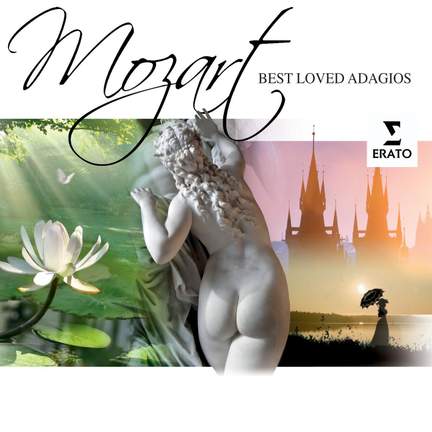
Special offer. Mozart: Best Loved Adagios
Jean-Bernard Pommier (piano), Paul Meyer (clarinet), Naoko Yoshino (harp), Samuel Coles (flute), Antoine Tamestit (viola), Renaud Capuçon (violin), Mikhail Pletnev (piano), Barbara Hendricks (soprano), Natalie Dessay (soprano), Ensemble Vocal de Lausanne (vocal ensemble), Sinfonia Varsovia, Ensemble...
Purchase product
About
Just as his life was characterised by an alternation of painful crises and moments when everything seemed to be going well for him, so Mozart’s music juxtaposes serenity with austerity, gracefulness with pungency. He himself remarked that he fluctuated between joy and anguish. He was evidently a sensitive and rebellious individual, but in addition to being an artist who set himself the highest standards, he could also be cheerful and carefree. He was one of the first composers who dared to try to carve out a career as a freelance musician instead of being employed by the church and the court, seeking a freedom that only the Romantics were to realise fully. Mozart was determined to forge his own path, and for most of his life found spiritual fulfilment in freemasonry. His final years saw the composition of such masterpieces as the Clarinet Concerto, with its tender and dramatic slow movement, the poignant motet Ave verum corpus and the Requiem. It’s said that his friend, the singer Franz Xaver Gerl, struggled to fight back the tears as he sang the Lacrimosa from the Requiem at the foot of the dying composer’s bed.
By the time his death – at the age of 35, when he was already worn out by hard work and crushed by insurmountable financial difficulties – Mozart had established his mastery in every musical genre. He used the slow movements of his piano concertos as vehicles for his most intimate thoughts: deeply moving and often mysterious, these movements reveal intense emotion and in many cases genuine anguish.
Though the scale of the genius of this universal master can be hard to grasp, he continues to exert a powerful hold over the public. “Play me some real music. Play me some Mozart”, Chopin is recorded as having said.
Artists
Jean-Bernard Pommier (piano), Paul Meyer (clarinet), Naoko Yoshino (harp), Samuel Coles (flute), Antoine Tamestit (viola), Renaud Capuçon (violin), Mikhail Pletnev (piano), Barbara Hendricks (soprano), Natalie Dessay (soprano), Ensemble Vocal de Lausanne (vocal ensemble), Sinfonia Varsovia, Ensemble Orchestral de Paris, English Chamber Orchestra, Scottish Chamber Orchestra, Deutsche Kammerphilharmonie, Die Deutsche Kammerphilharmonie Bremen, Winchester Cathedral Choir, Academy of St Martin in the Fields, Academy of St Martin in the Fields Chorus, Le Concert d'Astrée, Orchestre de chambre de Genève, John Nelson, Yehudi Menuhin, Louis Langrée, David Hill, Sir Neville Marriner, Michel Corboz
Contents and tracklist
- Jean-Bernard Pommier (piano)
- Sinfonia Varsovia
- Jean-Bernard Pommier
- Recorded: 1988-05-10
- Recording Venue: 8-10 May 1988 / Bydgoszcz State Philharmony Concert Hall
- Jean-Bernard Pommier (piano)
- Sinfonia Varsovia
- Jean-Bernard Pommier
- Recorded: 1989-01-01
- Recording Venue: 8-10 May 1988 / Bydgoszcz State Philharmony Concert Hall
- Paul Meyer (clarinet)
- Ensemble Orchestral de Paris
- John Nelson
- Recorded: 2005-03-17
- Recording Venue: 11-17th March 2005. Eglise Notre Dame du Liban, Paris.
- Naoko Yoshino (harp), Samuel Coles (flute)
- English Chamber Orchestra
- Yehudi Menuhin
- Recorded: 1990-11-15
- Recording Venue: 13-15 November 1990 / Henry Wood Hall, London
- Antoine Tamestit (viola), Renaud Capuçon (violin)
- Scottish Chamber Orchestra
- Louis Langrée
- Recorded: 2007-09-17
- Recording Venue: 17-20 September 2007. Perth Concert Hall, Scotland.
- Deutsche Kammerphilharmonie, Mikhail Pletnev (piano)
- Die Deutsche Kammerphilharmonie Bremen
- Mikhail Pletnev
- Recorded: 1995-04-02
- Recording Venue: 1-2 April 1995 / Grosse Sendesaal, NDR, Hannover
- Winchester Cathedral Choir
- David Hill
- Recorded: 1998-01-01
- Recording Venue: 19-23 January 1998, Winchester Cathedral
- Barbara Hendricks (soprano)
- Academy of St Martin in the Fields, Academy of St Martin in the Fields Chorus
- Sir Neville Marriner
- Recorded: 1987-04-28
- Recording Venue: 24-28.IV.1987. Abbey Road Studios, London.
- Natalie Dessay (soprano)
- Le Concert d'Astrée
- Louis Langrée
- Recorded: 2006-01-31
- Recording Venue: 31 January - 4 February 2006 Eglise Notre Dame du Liban Paris
- Ensemble Vocal de Lausanne (vocal ensemble)
- Orchestre de chambre de Genève
- Michel Corboz
- Recorded: 1995-09-24
- Recording Venue: 24 September 1995. Live at the Fribourg Festival.