Dvořák: Stabat Mater, Op. 58
Alexandra Coku (soprano), Renata Pokupic (alto), Pavol Breslik (tenor), Markus Butter (bass) & Brigitte Engerer (piano)
Accentus, Laurence Equilbey
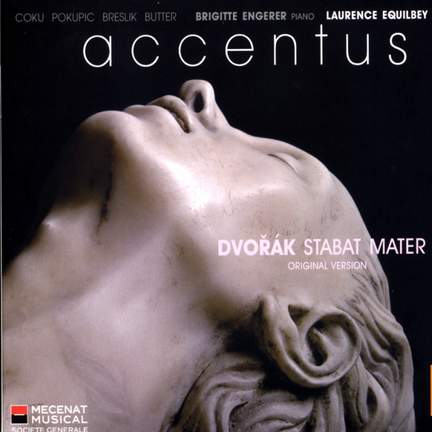
What Laurence Equilbey and her group have recorded for the first time is the original version of the score, with soloists, chorus and piano accompaniment, reconstructed from Dvorák's manuscript....
Dvořák: Stabat Mater, Op. 58
Alexandra Coku (soprano), Renata Pokupic (alto), Pavol Breslik (tenor), Markus Butter (bass) & Brigitte Engerer (piano)
Accentus, Laurence Equilbey
Purchase product
What Laurence Equilbey and her group have recorded for the first time is the original version of the score, with soloists, chorus and piano accompaniment, reconstructed from Dvorák's manuscript....
About
For Dvorak, the Stabat Mater was a work brought about by personal tragedy of almost incomprehensible proportions when he tragically lost all three of his then living children over a period of three years. In 1875, his young daughter Josefa died at only two days of age. The Stabat Mater is based on an ancient Roman Catholic poem that tells of the Virgin Mary’s grief over the crucifixion of Jesus as she is standing under his cross, and the grieving father began work on the Stabat Mater as a means of coping with his beloved child’s death. The sadness which Dvorak instilled in the piece was then compounded on August the 13th 1877 when 11 month old Ruzena accidentally drank a phosphorus solution and died. Less than one month later, on September 8th, his 3-year old son Otakar died of smallpox, leaving Dvorak and his wife completely childless. They subsequently had other children but at the time, their grief must have been overwhelming. The composer’s only means of emotional survival was by burying himself in his Stabat Mater, which he completed on November 13th of that year. The recording here is of the composer’s original version for soloists, choir, and piano. He later arranged the Stabat Mater to incorporate a full orchestra.
Contents and tracklist
- Laurence Equilbey, Accentus, Brigitte Engerer, Alexandra Coku, Markus Butter, Pavol Breslik, Renata Pokupić
Awards and reviews
 2nd May 2008
What Laurence Equilbey and her group have recorded for the first time is the original version of the score, with soloists, chorus and piano accompaniment, reconstructed from Dvorák's manuscript. I'm not sure, though, that hearing this first attempt does the work many favours. For all the suaveness of Equilbey's performance, it never really establishes its own identity or makes a convincing case for the piano accompaniment, which too often seems like a surrogate for the full orchestral textures. Some of Dvorák's piano writing even sounds as though it's a reduction, rather than originally conceived for the instrument. A historical curiosity, certainly - but little more.