Blacher, B: String Quartets
String Quartet (STR 4TET)
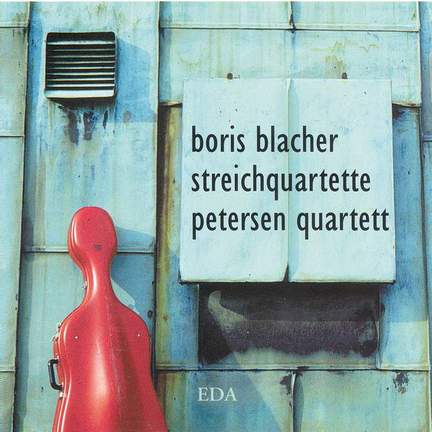
Blacher, B: String Quartets
String Quartet (STR 4TET)
Purchase product
About
1930, 1940, 1944, 1951, 1967 – the years in which Blacher’s five complete string quartets were created not only read like a list of historical landmarks (or turning points) in German history, they also recall stations, junctions, and wrong turns in national – and occasionally nationalistic – musical development on “German” soil. The stateless Blacher enjoyed the unusual path of the outsider his whole life long – which he celebrated in his unique – and grand – life work. Never concerned with tradition, “taste” and the spirit of the times, Blacher always stood out from the rest, and was seen as the composer who probably had the fewest notes per piece, but always said just what he needed to. What this meant in 1930 was the music of the roaring, dancing, swirling Berlin, in 1940 (on order of the Biennale in Venice), mockery and irony after nearly a decade of music decreed by the Nazi party, and in 1944 a remnant of a music culture which had nearly gone under. In 1951, Blacher went on to write “Epitaph” in commemoration of Franz Kafka, whose literature seemed to combine the thoughts of both blocks of political systems which appeared in the post-war era in its own time. In 1967, at the zenith of his timeless mastery and the pinnacle of his carrier, all it took him was a single triad in C-minor to create one of the most daring works of quartet literature, a unique and fulminant piece which puts great demands on instrumentalists and holds many surprises for listeners – and uses variable meters, the favourite hobbyhorse and trademark of the mathematician (and architect) Boris Blacher. With the help of the Pro Musica Viva foundation, eda records captured all of Blacher’s quartets for the first time, performed by the Petersen Quartet. The recording received many awards and stands as the reference recording to date.
Contents
- String Quartet no. 1 (1930)
- String Quartet no. 2 (1940)
- String Quartet no. 3 (1944)
- String Quartet no. 4 "Epitaph" (1951)
- String Quartet no. 5 "Variations" (1967)