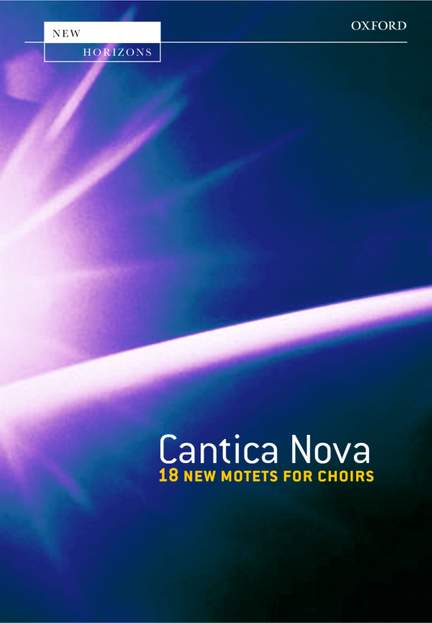
Quantity deal. Cantica Nova
18 new motets for choirs
SATB accompanied & unaccompanied (SATB)

Oxford University Press, one of the world's major publishers of choral music, has done it again . . . both Blackwell and OUP are to be congratulated for such an innovative and comprehensive...
Quantity deal. Cantica Nova
18 new motets for choirs
SATB accompanied & unaccompanied (SATB)
Purchase product
Oxford University Press, one of the world's major publishers of choral music, has done it again . . . both Blackwell and OUP are to be congratulated for such an innovative and comprehensive...
About
for SATB, with organ and unaccompanied Cantica Nova is an outstanding collection of motets by contemporary British composers. The pieces present a kaleidoscope of different styles and sonorities, united in their ability to communicate fresh ideas and the skill of their vocal writing. Encompassing a wide range of texts, with settings of some of the great hymns of the Church alongside little known, rarely set texts, the collection will be welcomed by concert and church choirs seeking innovative and exciting contemporary repertoire.
Contents
- Kerry Andrew: O lux beata Trinitas
- Michael Berkeley: Pasce agnos meos
- Alan Bullard: Ave maris stella
- Bob Chilcott: Pange lingua
- Michael Finnissy: Ave regina coelorum
- Andrew Gant: Ave verum corpus
- Gabriel Jackson: A Prayer of King Henry VI
- John Joubert: In medio Ecclesiae
- Tarik O'Regan: Surrexit Christus
- Joseph Phibbs: Ave verum corpus
- Jonathan Pitkin: Cantate Domino
- Francis Pott: Jesu dulcis memoria
- Anthony Powers: O magnum mysterium
- John Rutter: Veni Sancte Spiritus
- Andrew Simpson: Surge illuminare
- Howard Skempton: Ostende nobis Domine
- Will Todd: Christus est stella
- Roderick Williams: O Adonai et Dux domus Israel
Related products
-
Quantity deal. Berkeley, Michael: Pasce agnos meos$5.00
-
Quantity deal. Bullard, Alan: Ave maris stella$5.00
-
Quantity deal. Chilcott, Bob: Pange lingua$5.00
-
Quantity deal. Finnissy, Michael: Ave regina coelorum$5.00
-
Quantity deal. Gant, Andrew: Ave verum corpus$5.00
-
Quantity deal. Joubert, John: In medio Ecclesiae$5.00
-
Quantity deal. O'Regan, Tarik: Surrexit Christus$5.00
-
Quantity deal. Phibbs, Joseph: Ave verum corpus$5.00
-
Quantity deal. Pitkin, Jonathan: Cantate Domino$5.00
-
Quantity deal. Pott, Francis: Jesu dulcis memoria$5.00
-
Quantity deal. Powers, Anthony: O magnum mysterium$5.00
-
Quantity deal. Simpson, Andrew: Surge illuminare$6.00
-
Quantity deal. Skempton, Howard: Ostende nobis Domine$5.00


Awards and reviews

Oxford University Press, one of the world's major publishers of choral music, has done it again . . . both Blackwell and OUP are to be congratulated for such an innovative and comprehensive addition to choral publishing. The collection bears the OUP hallmark: the clearly laid-out scores with keyboard reductions . . . It should be emphasised that all the pieces are worthy of thorough examination and it is to be hoped that choral directors and singers alike will explore this vast treasure-trove for themselves . . . Cantica Nova not only provides singers and choral directors with an outstanding resource but is a fascinating insight into choral composing in the UK today