New. Albert Ayler Spirits & Spirits Rejoice
Albert Ayler (saxophone)
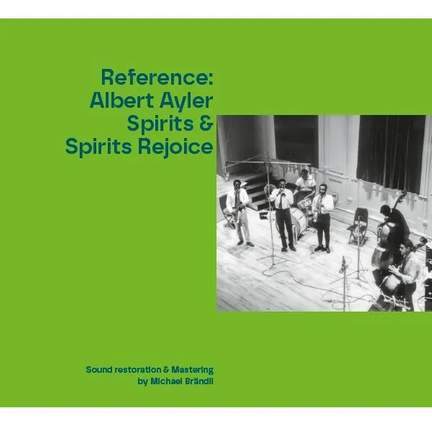
New. Albert Ayler Spirits & Spirits Rejoice
Albert Ayler (saxophone)
Purchase product
About
Released on a Copenhagen-based debut label, "Spirits" in February 1964 in New York
marked his first opportunity to record his own "free music." The musicians were hand-selected by him, including Cecil Taylor (drummer Sonny Murray), one of his early inspirations, Sonny Rollins' band (bassist Henry Grimes), and members from his Cleveland days (trumpeter Norman Howard and bassist Earl Henderson)
. It was also his first work to focus on his own compositions (including Howard's "Witches and Devils").
The concept is unique, but the expression of vorticism is applicable. Energy is generated from the interacting lines of horns and percussion, harmonies unfold simultaneously through two bass lines played by bowed and stringed instruments, and there is a dramatic sense of "chaos invading the concept." Furthermore, this ensemble has a sculptural quality, with contrapuntal melodic lines overlapping, fusing, and separating on the "plane" of related tonal colors. Howard's sharp trumpet tone and Ayler's heavy tenor saxophone sound as if they have been carved from a hard surface.
The 17 months between "Spirits" and "Spirits Rejoice" were filled with activities that brought about significant changes to Ayler's music and life. He reduced his quintet to a trio and produced the ESP live recording that shocked the jazz world. Afterwards, he expanded the ensemble in sessions with Eye & Ear Control and Bells in New York, changing the group's dynamics. After working for a while in New York with an unrecorded band that included pianist Paul Bley (whose "Albert's Love Theme," composed by his then-wife Annette Peacock, later remained in Bley's repertoire), he returned to Scandinavia with a quartet that included Don Cherry, and upon returning to America, he brought in his brother Donald as trumpeter in Cherry's place. Energy is synonymous with intensity, and intensity does not depend on speed or volume in its effect.
"Spirits Rejoice" evokes a fluid intensity rather than meticulously crafted detail. The title track's invigorating fanfare (which converges into "La Marseillaise"), the enthusiastic horns, the surging bass, and the relentless drums foreshadow a new direction for Ayler's ensemble the following year, while the rest of the album offers different perspectives. "Holy Family" deals with a bright and cheerful theme, in contrast to the intense and obsessive "Prophet." "DC" reveals that its key motifs reflect themes Don Cherry had previously recorded with Ayler under the title "Infant Happiness," and later revisited in "Elephantacy" and "Awake Noo." (Excerpt from liner notes)
Contents and tracklist
(trks.1-4 'Spirits To Ghosts') Spirits; Witches And Devils; Holy, Holy; Saints;
(trks. 5-9 'Spiirits Rejoice') Spirits Rejoice; Holy Family; D.C.; Angels; Prophet
rec. (Spirits To Ghosts) February 24, 1964 in New York; (Spirits Rejoice) September 23, 1965 at Judson Hall, New York
●1~4
Albert Ayler tenor saxophone
Norman Howard trumpet
Henry Grimes double bass,
tracks 1, 2 + 4
Earle Henderson double bass,
tracks 3 + 4
Sunny Murray drums
Recorded February 24, 1964 in
New York.
●5~9
Albert Ayler tenor saxophone
Donald Ayler trumpet
Charles Tyler alto saxophone
Call Cobbs harpsichord, track 8
Henry Grimes double bass
Gary Peacock double bass
Sunny Murray drums
Recorded September 23, 1965 at
Judson Hall, New York