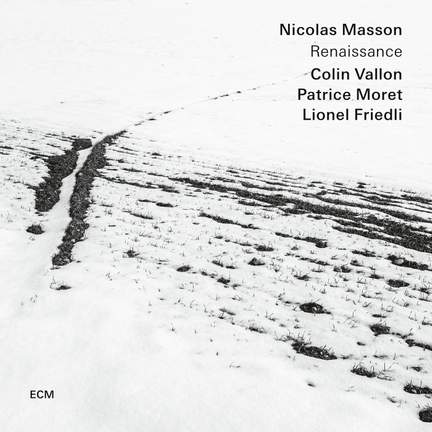
Renaissance
Nicolas Masson (saxophone), Colin Vallon (piano), Patrice Moret (doublebass), Lionel Friedli (drumkit)
The nine tracks here are all originals (Masson’s, except for one collective improvisation), and reflect his recent inclinations to let early interests in free jazz bloom again, and cherish the...
Renaissance
Nicolas Masson (saxophone), Colin Vallon (piano), Patrice Moret (doublebass), Lionel Friedli (drumkit)
Purchase product
The nine tracks here are all originals (Masson’s, except for one collective improvisation), and reflect his recent inclinations to let early interests in free jazz bloom again, and cherish the...
About
Nicolas Masson’s acquaintance with his fellow quartet travelers Colin Vallon, Patrice Moret and Lionel Friedli goes back roughly two decades – in this time the players have developed an intimate musical bond, expressed purely and beautifully on Renaissance, the group’s second recording for ECM after 2018’s Travelers. Comprised exclusively of originals by the Swiss saxophonist and one collective improvisation, the album’s spotlight shifts between contrasting moods and shapes, capturing the venturesome leader stretching his compositional muscle in evocative interplay with his colleagues. The band is in a searching spirit on rubato exercises like the expressive “Tremolo” or the ambient “Tumbleweeds”, mathematical on the more cerebral cuts like “Renaissance”, but always operate with a lyrical disposition at heart, as heard elsewhere on the record and with a particularly gripping melodiousness on “Anemona”. The album was recorded at Studios La Buissonne in Southern France.
Contents and tracklist
- Nicolas Masson (saxophone), Colin Vallon (piano), Patrice Moret (doublebass), Lionel Friedli (drumkit)
- Recorded: 2023-11
- Recording Venue: Studios La Buissonne, Pernes-Les-Fontaines
- Nicolas Masson (saxophone), Colin Vallon (piano), Patrice Moret (doublebass), Lionel Friedli (drumkit)
- Recorded: 2023-11
- Recording Venue: Studios La Buissonne, Pernes-Les-Fontaines
- Nicolas Masson (saxophone), Colin Vallon (piano), Patrice Moret (doublebass), Lionel Friedli (drumkit)
- Recorded: 2023-11
- Recording Venue: Studios La Buissonne, Pernes-Les-Fontaines
- Nicolas Masson (saxophone), Colin Vallon (piano), Patrice Moret (doublebass), Lionel Friedli (drumkit)
- Recorded: 2023-11
- Recording Venue: Studios La Buissonne, Pernes-Les-Fontaines
- Nicolas Masson (saxophone), Colin Vallon (piano), Patrice Moret (doublebass), Lionel Friedli (drumkit)
- Recorded: 2023-11
- Recording Venue: Studios La Buissonne, Pernes-Les-Fontaines
- Nicolas Masson (saxophone), Colin Vallon (piano), Patrice Moret (doublebass), Lionel Friedli (drumkit)
- Recorded: 2023-11
- Recording Venue: Studios La Buissonne, Pernes-Les-Fontaines
- Nicolas Masson (saxophone), Colin Vallon (piano), Patrice Moret (doublebass), Lionel Friedli (drumkit)
- Recorded: 2023-11
- Recording Venue: Studios La Buissonne, Pernes-Les-Fontaines
- Nicolas Masson (saxophone), Colin Vallon (piano), Patrice Moret (doublebass), Lionel Friedli (drumkit)
- Recorded: 2023-11
- Recording Venue: Studios La Buissonne, Pernes-Les-Fontaines
- Nicolas Masson (saxophone), Colin Vallon (piano), Patrice Moret (doublebass), Lionel Friedli (drumkit)
- Recorded: 2023-11
- Recording Venue: Studios La Buissonne, Pernes-Les-Fontaines
- Nicolas Masson (saxophone), Colin Vallon (piano), Patrice Moret (doublebass), Lionel Friedli (drumkit)
- Recorded: 2023-11
- Recording Venue: Studios La Buissonne, Pernes-Les-Fontaines
- Nicolas Masson (saxophone), Colin Vallon (piano), Patrice Moret (doublebass), Lionel Friedli (drumkit)
- Recorded: 2023-11
- Recording Venue: Studios La Buissonne, Pernes-Les-Fontaines
Awards and reviews
 April 2025
The nine tracks here are all originals (Masson’s, except for one collective improvisation), and reflect his recent inclinations to let early interests in free jazz bloom again, and cherish the insights of his major role model, Paul Motian.