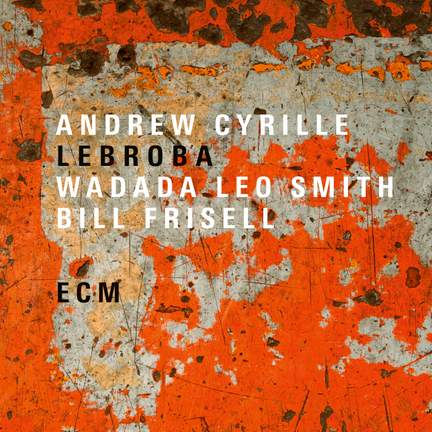
Lebroba
Wadada Leo Smith (trumpet), Bill Frisell (guitar), Andrew Cyrille (drums)
Awards:
-
Rolling Stone, 20 Best Jazz Albums of 2018

There is a kind of hovering, floating quality in much of Cyrille’s playing, which has a flexible pulse and carefully shaded timbres, particularly his cymbal work, which blends effectively with...
Lebroba
Wadada Leo Smith (trumpet), Bill Frisell (guitar), Andrew Cyrille (drums)
Purchase product
Awards:
-
Rolling Stone, 20 Best Jazz Albums of 2018
There is a kind of hovering, floating quality in much of Cyrille’s playing, which has a flexible pulse and carefully shaded timbres, particularly his cymbal work, which blends effectively with...
About
Andrew Cyrille’s title Lebroba is a contraction of Leland, Brooklyn and Baltimore, birthplaces of the protagonists of an album bringing together three of creative music’s independent thinkers. Each of them made his first ECM appearance long ago: drummer Andrew Cyrille on Marion Brown’s Afternoon of a Georgia Faun (1970), trumpeter Wadada
Leo Smith on his own classic Divine Love (1978), and guitarist Bill Frisell on Eberhard Weber’s Fluid Rustle (1979); these are, of course, players of enduring influence. Frisell contributed to Cyrille’s previous ECM disc The Declaration of Musical Independence, but Lebroba marks a first-time meeting for the guitarist and Wadada Leo Smith. A generous leader, Cyrille gives plenty of room to his cohorts, and all three musicians bring in compositions, with “Turiya”, Wadada’s elegant dedication to Alice Coltrane, unfurling slowly over its 17-minute duration. In his own pieces, including the title track and the closing “Pretty Beauty”, Cyrille rarely puts the focus on the drums, preferring to play melodically and interactively, sensitive to pitch and to space. There are references to West African music and the blues as well as the history of jazz drumming, but Cyrille’s priority today is an elliptical style in which meter is implied rather than stated. The recording is made available in both CD and LP formats.
Contents and tracklist
- Andrew Cyrille (drums), Wadada Leo Smith (trumpet), Bill Frisell (guitar)
- Recorded: 2017-07
- Recording Venue: Reservoir Studios, New York City
- Andrew Cyrille (drums), Wadada Leo Smith (trumpet), Bill Frisell (guitar)
- Recorded: 2017-07
- Recording Venue: Reservoir Studios, New York City
- Andrew Cyrille (drums), Wadada Leo Smith (trumpet), Bill Frisell (guitar)
- Recorded: 2017-07
- Recording Venue: Reservoir Studios, New York City
- Andrew Cyrille (drums), Wadada Leo Smith (trumpet), Bill Frisell (guitar)
- Recorded: 2017-07
- Recording Venue: Reservoir Studios, New York City
- Andrew Cyrille (drums), Wadada Leo Smith (trumpet), Bill Frisell (guitar)
- Recorded: 2017-07
- Recording Venue: Reservoir Studios, New York City
Awards and reviews
-
Rolling Stone20 Best Jazz Albums of 2018
 March 2019
There is a kind of hovering, floating quality in much of Cyrille’s playing, which has a flexible pulse and carefully shaded timbres, particularly his cymbal work, which blends effectively with the languorous character of Frisell’s chords and single-note spirals and the shimmer of Smith’s brass. All of which suits material that often has a quality of deep lament, with melodies emerging, flickering and submerging without neat interludes or turnarounds, though there are wellhandled peaks of energy in which Smith, in particular, stokes a mighty fire.
 January 2019
Rather than fronting the proceedings by flaunting his chops, Cyrille underscores Lebroba with a combination of grace, zen-like restraint and authority