Bushra El-Turk: Three Tributes
Dudok Quartet (string quartet), Bushra El-Turk
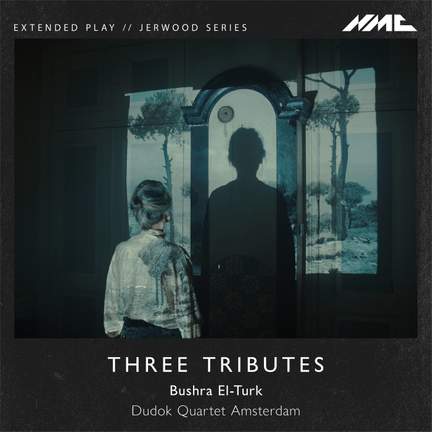
This is an appealing, postmodern collage, an attempt to remember, imagine and invent history and identity - a novel by Sebald, Elias Khoury or Hoda Barakat, in sound.
Bushra El-Turk: Three Tributes
Dudok Quartet (string quartet), Bushra El-Turk
Purchase product
This is an appealing, postmodern collage, an attempt to remember, imagine and invent history and identity - a novel by Sebald, Elias Khoury or Hoda Barakat, in sound.
About
Bushra El-Turk is a British-born Lebanese composer whose music has been performed by the London Symphony Orchestra, BBC Symphony Orchestra, London Sinfonietta, Royal Opera House, Festival d'Aix and Wiener Festwochen, and whose opera 'Woman at Point Zero' won an Ivor Novello Award.
Three Tributes is a set of three string quartet pieces that honour three female Levantine singers from the Nahda - the cultural renaissance of the Arabic-speaking world in the mid-19th to early 20th centuries. The work blends Western string quartet writing with Eastern vocal traditions, archival recordings, improvisational elements, and musical fragments inspired by traditional Arabic genres. El-Turk’s aim is both to give voice to historically overlooked women and to let performers’ personalities come through in the music.
Tribute I (Zakieh Agob)
This tribute celebrates Zakieh Agob, a Lebanese-American singer born around 1886-88 whose life remains elusive through many names and scant historical data. Agob is significant for being among the first Arab-American singers to record for Columbia and for her life of perseverance as a working mother and widowed artist. El-Turk’s music draws on fragments of the dawr - an Arabic vocal genre sung in colloquial language - and is titled after the song Lama kawani al hob ya nass (“When love burned my heart”), capturing Agob’s resilient spirit.
Tribute II (Haseeba Mowshe)
Dedicated to Haseeba Mowsheh, a singer from Beirut who achieved local fame in the early 1900s. This movement can be performed alongside an archival 1908 recording of the Syrian folk song ‘Under Her Howdah, woe is me’, which hovers as a shadowed melody behind the quartet’s texture. Its reflective interplay between past recording and present ensemble evokes Mowshe’s presence through fragmented musical memory.
Tribute III (Rasmiya Jumaa)
The final portrait honours Rasmiya Jumaa, a blind oud player who performed only for women due to her faith. No recordings of her voice exist, but El-Turk reimagines a muwasshah - the classical Andalusian poetic and musical form “Ya Ghosn al Naqa” - as a homage, imagining how Jumaa might have sung it.
Contents and tracklist
Awards and reviews
 June 2026
This is an appealing, postmodern collage, an attempt to remember, imagine and invent history and identity - a novel by Sebald, Elias Khoury or Hoda Barakat, in sound.