New. Darkness
Thilo Dahlmann (bass-baritone), Hedayet Djeddikar (piano)
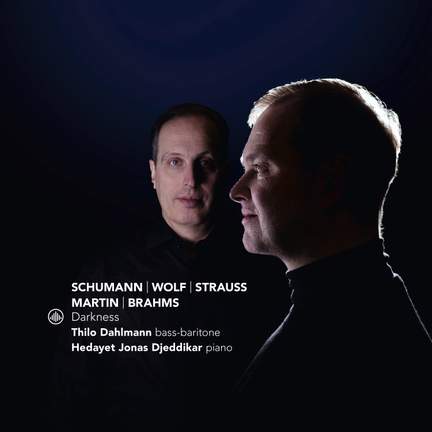
Thilo Dahlmann and Hedayet Djeddikar are clearly aligned in darkly warm, sensitive performances - and the slight edge to Dahlmann's voice suits the barbed subject matter well. But passion remains...
New. Darkness
Thilo Dahlmann (bass-baritone), Hedayet Djeddikar (piano)
Purchase product
Thilo Dahlmann and Hedayet Djeddikar are clearly aligned in darkly warm, sensitive performances - and the slight edge to Dahlmann's voice suits the barbed subject matter well. But passion remains...
About
Darkness explores the symbolic depth of the bass and baritone voice as a vessel for humanity’s most profound questions. Across works by Schumann, Wolf, Strauss, Martin and Brahms, the album traces a wide emotional and spiritual landscape shaped by themes of death, transience, loneliness, melancholy and, ultimately, transcendence.
The programme opens with Schumann’s Requiem, added as a tribute to Nikolaus Lenau and placed at the beginning as a motto: a union of heaviness, longing and gentle, affirmative melancholy. From there, the journey unfolds through composers often writing at pivotal or final stages of their lives. Wolf’s Michelangelo Songs, composed shortly before his mental collapse, meditate on love, devotion and artistic melancholy; Strauss’s dark-hued songs reflect retreat, solitude and a wistful dissolution into nature; and Frank Martin’s Six Monologues from Jedermann plunge into the raw confrontation with death, charting a moral and spiritual transformation from terror to humility and faith. Together, these works reveal darkness not as mere despair, but as a space in which existential truth is sought.
Yet this album is not confined to shadow alone. In both Wolf and Brahms, the selected works bear witness to late creative phases in which despair is counterbalanced by reconciliation. Brahms’s Vier ernste Gesänge, written in anticipation of loss and drawing on biblical texts, move from stark reflections on mortality toward a final affirmation of love as the greatest human force, closing the circle begun with Schumann’s Requiem.
Throughout the programme, sorrow is repeatedly transformed into acceptance, and fear into insight, illuminated by what the liner notes describe as a “gentle compositional light.” Darkness thus becomes a deeply human meditation: an artistic passage through emotional abysses toward consolation, spiritual clarity and an enduring sense of love that transcends life and death.
Contents and tracklist
Awards and reviews
 July 2026
Thilo Dahlmann and Hedayet Djeddikar are clearly aligned in darkly warm, sensitive performances - and the slight edge to Dahlmann's voice suits the barbed subject matter well. But passion remains elusive.