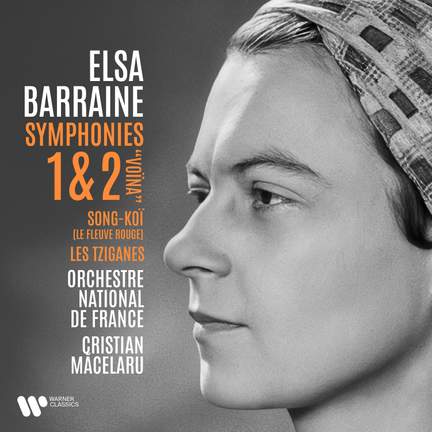
Elsa Barraine: Symphonies 1 & 2
Orchestre National de France, Cristian Măcelaru
Awards:
-
Presto Recording of the Week, 20th February 2026

-
BBC Music Magazine, April 2026, Orchestral Choice

The Orchestre National de France and Cristian Măcelaru aren’t the first to champion the French composer’s forgotten music, but in these punchy performances they make a powerful case for her...
Elsa Barraine: Symphonies 1 & 2
Orchestre National de France, Cristian Măcelaru
Purchase product
Awards:
-
Presto Recording of the Week, 20th February 2026
-
BBC Music Magazine, April 2026, Orchestral Choice
The Orchestre National de France and Cristian Măcelaru aren’t the first to champion the French composer’s forgotten music, but in these punchy performances they make a powerful case for her...
About
Elsa Barraine, a notable and politically intrepid figure in her lifetime (1910-1999), is a composer whose distinctive voice is being heard again. A pupil of Paul Dukas at the Paris Conservatoire, and a fellow student of Olivier Messiaen, at the age of 19 she won the highly prestigious Prix de Rome with a cantata on the theme of Joan of Arc. During her long career she held several public posts in French music and spent more than 20 years as a professor, but she was also a composer of strong left-wing convictions and prominent in the Resistance during the Occupation years of World War Two.
Under its music director Cristian Măcelaru, the Orchestre national de France performs four works by Barraine: the Symphony No 1, completed in Italy in 1931; the compact, but powerful Symphony No 2, composed in 1938 and ominously subtitled ‘Voïna’, the French transliteration of the Russian word for ‘war’; Song-Koï (Le Fleuve rouge) – an eight-movement evocation of the Red River which flows through Vietnam, composed in 1945, the year Vietnam declared its independence from France, and, dating from 1959, Les Tziganes, which, as its name implies, takes inspiration from gypsy culture. Rooted in tonality, Barraine’s music is confidently and soberly crafted, its orchestral palette both clearly defined and subtly shaded as it reflects its times and the composer’s philosophical and spiritual concerns.
Contents and tracklist
Spotlight on this release
-
Cristian Măcelaru on Elsa Barraine
2nd Apr 2026
The Romanian conductor discusses the remarkable legacy of 'one of the most prominent figures in twentieth-century French cultural life', whose symphonies he recently recorded with the Orchestre National de France for Warner Classics.
-
Symphonic works by Elsa Barraine
20th Feb 2026
Two symphonies and a pair of pictorial tone-poems show the long-neglected twentieth-century French composer at her finest, with a musical language drawing on both watercolour Impressionism and bold modernism.


Awards and reviews
-
Presto Recording of the Week20th February 2026
-
BBC Music MagazineApril 2026Orchestral Choice
 April 2026
The Orchestre National de France and Cristian Măcelaru aren’t the first to champion the French composer’s forgotten music, but in these punchy performances they make a powerful case for her orchestral prowess… Here is a composer who compellingly captures the serious undercurrents of her historical moment.
 April 2026
Măcelaru gives these Adagio outer sections with quasi-Brucknerian fervour...The Orchestre National de France play with commitment and polish for Măcelaru, and Warner Classics' recording is warm.
 20th February 2026
Her music evokes harder-edged styles such as those of Walton, Prokofiev and the later Shostakovich, while at the same time retaining distinctively French qualities, particularly in her use of distinctive orchestral colours. Măcelaru’s balancing of these - mixing the palette, as it were - is impeccable throughout, with instruments coming out of the texture when required, either as deliberately prominent features or as subtler shades.