Mozart: The String Quintets
Oleg Kaskiv, Alexander Grytsayenko, Eli Karanfilova, Valentyna Pryshlyak, Pablo de Naverán
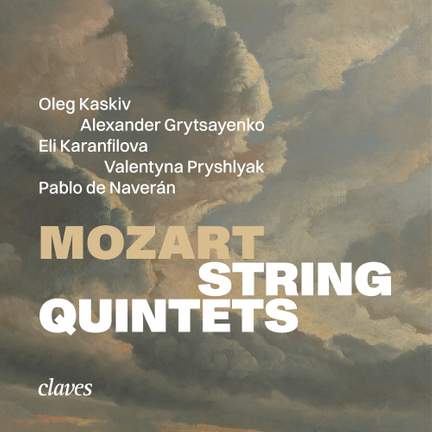
Mozart: The String Quintets
Oleg Kaskiv, Alexander Grytsayenko, Eli Karanfilova, Valentyna Pryshlyak, Pablo de Naverán
Purchase product
About
While the string quartet underwent its well-known development from the 1760s onwards, the string quintet – perhaps created by Michael Haydn in 1773 – remained somewhat marginal. The young Wolfgang Amadeus, then seventeen, discovered the genre on his return from Italy. This was enough to inspire the teenager, who loved playing the viola part when performing quartets. After Mozart’s six quintets with two violas, this scoring remained uncommon – Boccherini composed over a hundred quintets, but with two cellos, as did Schubert – perhaps because the genre struggled to distinguish itself from entertainment music. Michael Haydn entitled his first quintet Notturno, while Mozart wrote his first quintet in the style of a divertimento.
The first Quintet K. 174, in B-flat major, was a product of the creative explosion of 1773, an extremely fertile year, alongside Mozart’s piano concerto in D major, three symphonies, and six quartets dedicated to Joseph Haydn. After a first version composed in the spring, the piece underwent extensive revisions during December. The Allegro, in sonata form, features a dialogue between the first violin and first viola; the ensuing development discloses a dramatic mood that contrasts with the recapitulation. Mutes give the Adagio its nocturnal feel, in a sonata form virtually devoid of development, which is reduced to a few bars. The Minuetto is a joyful and straightforward movement that revives the dialogue between the first violin and first viola. The Finale occupies almost half the duration of the whole work; this disproportionate movement is nevertheless “one of the most ambitious and elaborate sonata forms conceived by the young Mozart” (H. Halbreich). The exposition presents a first theme in repeated quavers, to which the cello responds with a semiquaver motif that is also woven into the development. This leads first to a “false recapitulation” of the kind Haydn favoured in his quartets. After a highly modulating passage, the true recapitulation finally comes forth. Despite his youth, the 17-year-old Mozart is already a master of the genre.
Following this initial quintet, the next two were composed only fourteen years later. They were written in 1787, after the success of The Marriage of Figaro in Prague and before the premiere of Don Giovanni. These two extensive works – composed respectively in a solemn and serene C major and an anguished G minor – are remarkable masterpieces from the composer’s mature period. Their creation has been linked to a letter Mozart wrote to his father, who was then seriously ill and would die less than two weeks later. [..]
Contents and tracklist
- Oleg Kaskiv, Alexander Grytsayenko, Eli Karanfilova, Valentyna Pryshlyak, Pablo de Naverán
- Oleg Kaskiv, Alexander Grytsayenko, Eli Karanfilova, Valentyna Pryshlyak, Pablo de Naverán
- Oleg Kaskiv, Alexander Grytsayenko, Eli Karanfilova, Valentyna Pryshlyak, Pablo de Naverán
- Oleg Kaskiv, Alexander Grytsayenko, Eli Karanfilova, Valentyna Pryshlyak, Pablo de Naverán
- Oleg Kaskiv, Alexander Grytsayenko, Eli Karanfilova, Valentyna Pryshlyak, Pablo de Naverán
- Oleg Kaskiv, Alexander Grytsayenko, Eli Karanfilova, Valentyna Pryshlyak, Pablo de Naverán
Spotlight on this release
-
An error occurred.
Try watching this video on www.youtube.com, or enable JavaScript if it is disabled in your browser.
-
An error occurred.
Try watching this video on www.youtube.com, or enable JavaScript if it is disabled in your browser.
-
An error occurred.
Try watching this video on www.youtube.com, or enable JavaScript if it is disabled in your browser.