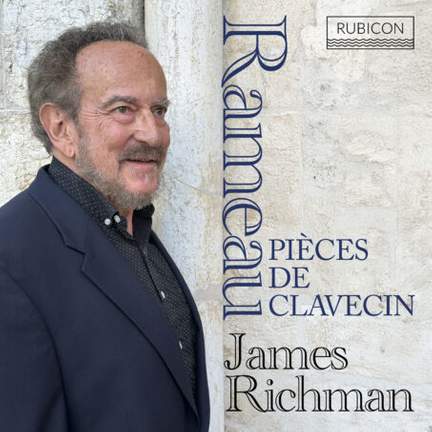
Special offer. Rameau: Pièces de Clavecin
James Richman (harpsichord)
not for Richman the flamboyance of a Christie or a Rousset, or the fantasy of a Rondeau or an Esfahani; he is content to allow his profound understanding and experience merely to give space...
Special offer. Rameau: Pièces de Clavecin
James Richman (harpsichord)
Purchase product
not for Richman the flamboyance of a Christie or a Rousset, or the fantasy of a Rondeau or an Esfahani; he is content to allow his profound understanding and experience merely to give space...
About
Rameau’s Pièces de Clavecin was composed over a period of 20 years, the first collection, or book appearing in 1706. These pieces showcase Rameau’s lyrical and expressive style, often featuring intricate ornamentation and elegant melodies. The collection is considered a major work in Baroque keyboard repertoire, reflecting Rameau’s mastery in both composition and harmony.
James Richman is the first musician since Leonard Bernstein to graduate Harvard, Julliard and the Curtis Institute of Music, studying conducting with Herbert Blomstedt, piano with Horszowski, and harpsichord with Kenneth Gilbert. He is considered one of today’s leading conductors of Baroque music and opera. James was made a Chevalier in the Ordre des Arts et des Lettres by the French government in 1995 in recognition of his contributions to the field of music.
This recording is played on a French double-manual harpsichord modeled closely after the 1769 instrument by Pascal Taskin, built by John Koster, formerly curator of keyboards at the National Music Museum as well as the Boston Museum of Fine Arts. The instrument, built in 1980, was recently refurbished and voiced by Claire Hammett of London and Sarasota, Florida.
Contents and tracklist
Awards and reviews
 March 2026
not for Richman the flamboyance of a Christie or a Rousset, or the fantasy of a Rondeau or an Esfahani; he is content to allow his profound understanding and experience merely to give space and breath and light to the music, avoiding excessively brisk tempos and too-emphatic articulation, agréments or agogics.