Arensky & Rachmaninoff: Romances
Anastasia Prokofieva (soprano), Sergey Rybin (piano)
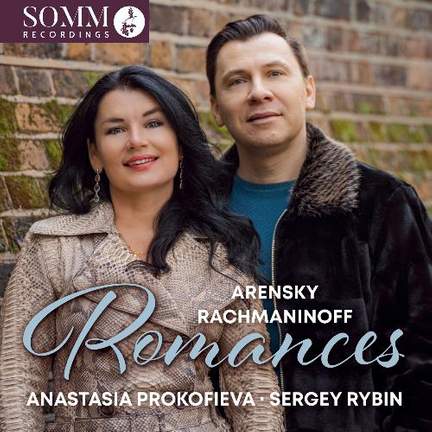
The two artists are steeped in the Russian song tradition. Theirs is a visionary account, for instance, of 'How fair this spot'. Sergey Rybin's discrete playing nicely balances soprano Anastasia...
Arensky & Rachmaninoff: Romances
Anastasia Prokofieva (soprano), Sergey Rybin (piano)
Purchase product
The two artists are steeped in the Russian song tradition. Theirs is a visionary account, for instance, of 'How fair this spot'. Sergey Rybin's discrete playing nicely balances soprano Anastasia...
About
SOMM Recordings presents a seductive and captivating release of Russian art songs, an intriguing juxtaposition of Russian Romances for voice and piano by Anton Arensky (1861–1906) and his student Sergei Rachmaninoff (1873 – 1943).
While there is no doubt that Rachmaninoff was possessed of a unique and innate musical gift, he acknowledged the profound influence of his teacher and mentor, Arensky, who was his professor of harmony, counterpoint, and free composition at the Moscow Conservatory between 1885 and 1888, when Rachmaninoff was still a teenager. Arensky’s writing—and Rachmaninoff’s, too—is full of eminently singable melodies that are deeply connected both to bel canto and to a Russian folk aesthetic. Sergey Rybin also makes the point that a certain virtuosic flair in the piano parts of these románsy, by both the professor and the pupil, “are unmistakably the branches of the same stylistic tree.” Anton Arensky studied composition with Nikolai Rimsky-Korsakov at the St. Petersburg Conservatory, and he was just twenty-one when he began teaching harmony and counterpoint—and, later, instrumentation and free composition—at the Moscow Conservatory. While his role as a teacher may well be his most lasting contribution, he remained active as a composer of operas, symphonies, concertos, chamber music, and piano works. He also wrote fifty-seven románsy, which show his affinity for intimate, emotional expression. Included amongst the thirteen art songs by Arensky on this release are the Five Romances, Op. 70 from 1900, and the five-song cycle Reminiscence, Op. 71 circa 1905.
Before Rachmaninoff left Russia permanently in 1917, he composed a total of eighty-three románsy for voice and piano. His gift for lush melodies, expansive emotional range, and exceptionally difficult piano works makes him one of the last great Romantic pianist-composers, and these stellar qualities are evident in his art songs. Thirteen are presented on this programme. The earliest, from his Six Songs, Op. 8 written in 1893, include Child! You are as beautiful as a flower and Dream. The Twelve Songs, Op. 21, composed in 1902, include some of his finest vocal writing, Lilacs being an exquisite example. Rachmaninoff’s last compositions in the genre of románsy were the Six Songs, Op. 38 in 1916; four from this set close the recital.
Contents and tracklist
Awards and reviews
 March 2026
The two artists are steeped in the Russian song tradition. Theirs is a visionary account, for instance, of 'How fair this spot'. Sergey Rybin's discrete playing nicely balances soprano Anastasia Prokofieva's often delicate, sometimes more full-blooded voice in natural accounts.
 March 2026
Prokofieva's approach is idiosyncratic but consistent: she creates a lyric soprano sound that is intimate and seductive, with frequent portamentos. Her diction approaches casual speech, with disappearing consonants, as if she was indeed performing to a group of friends gathered around the piano.