Special offer. Enescu & Mendelssohn: Octets
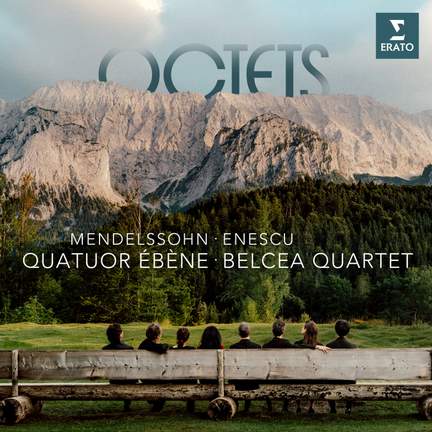
Quatuor Ébène, Belcea Quartet
Awards:
-
Presto Recording of the Week, 9th January 2026

-
Opus Klassik Awards, 2026, Winner - Orchestra/Ensemble of the Year

Recorded in the warm, generous acoustic of Schloss Elmau, this meeting of two flagship quartets sounds less like a joint venture than eight players sharing a single imagination...Few octet recordings...
Special offer. Enescu & Mendelssohn: Octets
Quatuor Ébène, Belcea Quartet
Purchase product
Awards:
-
Presto Recording of the Week, 9th January 2026
-
Opus Klassik Awards, 2026, Winner - Orchestra/Ensemble of the Year
Recorded in the warm, generous acoustic of Schloss Elmau, this meeting of two flagship quartets sounds less like a joint venture than eight players sharing a single imagination...Few octet recordings...
About
Two of the world’s leading string quartets, the Ebène and the Belcea, come together to perform octets written 75 years apart by two phenomenally gifted teenage composers, Felix Mendelssohn and George Enescu. The two ensembles, the Ebène based in Paris and the Belcea in London, first joined forces almost a decade ago and have developed their collaboration since then. When they played the Mendelssohn and Enescu octets in Philadelphia in November 2024, The Strad – an authoritative voice in the world of string music – wrote: “The phrase ‘luxury casting’ gets tossed around a lot, but seemed entirely appropriate here, as these two distinguished groups effortlessly fused their expertise – and had a blast doing it. The gutsy results had many people in the audience standing before the interval …” While Pierre Colombet, first violinist of Quatuor Ébène, takes the lead in Mendelssohn’s symphonically conceived octet, Corinna Belcea, founder of the eponymous quartet, captains the eight-person ensemble in the Enescu. Though trained in the UK, she, like George Enescu, was born in Romania. He was just 18, and living in Paris, when he wrote his octet in 1900, while Mendelssohn was even younger – a mere 16 years old – when he composed his octet in 1825 as a birthday gift for his violin teacher.
If Mendelssohn’s mastery played a defining role in music of the 19th century, Enescu, as an emblematic figure of the earlier 20th century, is remarkable for his synthesis of influences … Viennese, German and French, all imbued with the spirit of Romanian folk music. After the Ebène-Belcea ensemble’s performance of his octet at Wigmore Hall in London, Bachtrack recounted that “The final movement conjured up astonishing waves of sound, passion pouring forth from every pore, bows deployed with manic power, moments of sheer ecstasy. A quite thrilling conclusion.”
Contents and tracklist
Spotlight on this release
-
Mendelssohn and Enescu Octets from the Ébène and Belcea Quartets
9th Jan 2026
String octets from Mendelssohn and Enescu - both in their teens at the time of composition - show the two composers’ genius already in full flower. The Ébène and Belcea quartets give it their all and the results are spectacular.

Awards and reviews
-
Presto Recording of the Week9th January 2026
-
Opus Klassik Awards2026Winner - Orchestra/Ensemble of the Year
 March 2026
Recorded in the warm, generous acoustic of Schloss Elmau, this meeting of two flagship quartets sounds less like a joint venture than eight players sharing a single imagination...Few octet recordings so fully reconcile orchestral amplitude with chamber accountability and make it sound inevitable.
 9th January 2026
The ‘supergroup’ formed by the Ébène and Belcea quartets for this recording is among the most intense chamber music powerhouses that one could wish for, The Classical-inspired neatness of the Mendelssohn’s framework is perfectly offset by the Romantic near-excess of the Enescu. Absolutely enthralling from start to finish.
 28th January 2026
An eight-legged organism but moving as one, dazzlingly so in [the Mendelssohn’s] fast finale... I was swept away even more by the epic and fruity octet of the 18 year-old George Enescu...this is a work that truly makes you glad to be alive; glad too that the Belcea and Ébène quartets pooled their talents so effectively, with such poetry and drive.