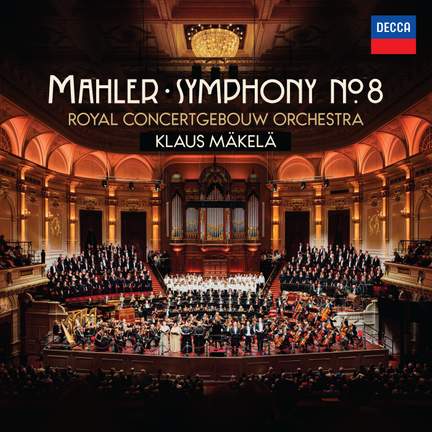
Mahler: Symphony No. 8
Hailey Clark, Golda Schultz (sopranos), Jennifer Johnston, Okka von der Damerau (mezzos), Giorgio Berrugi (tenor), Michael Nagy (baritone), Tareq Nazmi (bass)
Royal Concertgebouw Orchestra, Netherlands Radio Choir, Choeur de l'Orchestre de Paris et al, Klaus Mäkelä
Mäkelä elicits enthusiastic lucidity from up to 400 participants...If this Mahler lacks a certain emotional chiaroscuro, the results are fresh and engaging, never religiose.
Mahler: Symphony No. 8
Hailey Clark, Golda Schultz (sopranos), Jennifer Johnston, Okka von der Damerau (mezzos), Giorgio Berrugi (tenor), Michael Nagy (baritone), Tareq Nazmi (bass)
Royal Concertgebouw Orchestra, Netherlands Radio Choir, Choeur de l'Orchestre de Paris et al, Klaus Mäkelä
Purchase product
Mäkelä elicits enthusiastic lucidity from up to 400 participants...If this Mahler lacks a certain emotional chiaroscuro, the results are fresh and engaging, never religiose.
About
Decca Classics announces Klaus Mäkelä’s recording of Mahler’s Symphony No. 8, the
“Symphony of a Thousand” with the Royal Concertgebouw Orchestra. Mäkelä is the
Orchestra’s Conductor Designate, and the album was recorded live earlier this year at the
Mahler Festival, a major international event that took place for only the third time since 1920.
It will be available digitally worldwide from 7 November and released physically as a special
edition in Japan and Korea to coincide with the orchestra's first tour of Asia with Mäkelä.
The performances were captured live during the Mahler Festival in Amsterdam’s
Concertgebouw in May 2025. Two concerts, one on Friday evening and one on Sunday
afternoon, 18 May (the anniversary of Mahler’s death, in the presence of his granddaughter
Marina Mahler), gave rise to this special release. Mäkelä recalls: “Conducting Mahler’s
Eighth was one of the great moments of my life, which I will remember forever. I feel those
two performances really carried a very special momentum for everyone involved. I certainly
felt it on stage and hopefully it was also felt in the audience.”
The monumental forces included five choirs, among them the Chœur de l’Orchestre de
Paris, Netherlands Radio Choir, Laurens Symfonisch, Nationaal Kinderkoor and Nationaal
Jongenskoor, as well as eight international soloists. Mäkelä reflects: “Mahler used all these
instruments, all these incredible voices, all the counterpoint and the scale of the
orchestration simply because he needed all the colours, not because he needed more
power. Quite the opposite. During the rehearsals we worked hard on the transparency,
something that this hall is so perfect for, it has such personality. Every note that comes from
the stage, the hall gives it a colour.”
The reception in Amsterdam was remarkable. Bachtrack called it “a monumental Eighth from
Klaus Mäkelä and the Royal Concertgebouw”, praising the clarity of the Veni creator spiritus.
Trouw admired how he led the combined forces “with fantastic choirs from Hilversum, Paris,
Rotterdam, and with the intrepid National Children’s and Boys’ Choir”. For the young singers
themselves the experience was unforgettable: “Grandiose!” “Absolutely fantastic!”
“Unforgettable!” are the words that still resonate with members of the National Children’s
Choir and Boys’ Choir.
Mahler’s Eighth, premiered in1910, was the last new work he would hear in his lifetime and
one of his greatest triumphs. Mäkelä observes: “Each of Mahler’s symphonies is a way for
him to process major concerns in his life at that time. In the Eighth, he offers us a glimpse
into his spiritual life and religious beliefs. But it is also his true confession of love for Alma,
containing some of the most beautiful music he ever wrote. It’s a peek into Mahler’s inner
turmoil about his very complex emotions for Alma. Yes, it’s an extremely grand gesture, but
it’s also very intimate. I could never conduct this work without knowing the other
symphonies, and I really cherished the opportunity to conduct it in the context of the cycle,
particularly the Seventh, from which I feel the Eighth is a logical next step.”
The Concertgebouw Orchestra of Amsterdam is globally celebrated for its Mahler
interpretations, a tradition that began in 1903 when Mahler himself came to Amsterdam to
conduct his own work, notably the monumental Symphony No. 3 for orchestra, women’s
choir, children’s choir, and mezzo-soprano. This initial visit marked the beginning of a deep
collaboration between Mahler and the Concertgebouw Orchestra and a unique, enduring
tradition. This was largely the achievement of Willem Mengelberg, the orchestra’s second
chief conductor from 1895. Mengelberg, even in his youth, had a sharp nose for interesting
contemporary composers. With tireless missionary zeal, he championed Mahler’s works –
initially unknown and not very popular – to the Amsterdam public, and he succeeded.
Subsequent chief conductors, including Eduard van Beinum, Bernard Haitink, Riccardo
Chailly, and Mariss Jansons, have each added inspiring new chapters to this legacy. Future
chief conductor Klaus Mäkelä is ready to seamlessly adopt the Concertgebouw Orchestra’s
rich Mahler tradition.
Klaus Mäkelä has served as Chief Conductor of the Oslo Philharmonic since 2020 and
Music Director of the Orchestre de Paris since September 2021. In 2027 he will become
Chief Conductor of the Royal Concertgebouw Orchestra and Zell Music Director of the
Chicago Symphony Orchestra. As an exclusive Decca Classics artist, he has recorded three
albums with the Orchestre de Paris including Ballet Russes scores by Stravinsky and
Debussy, as well as Berlioz’s Symphonie fantastique and Ravel’s La Valse. With the Oslo
Philharmonic, he has recorded the complete Sibelius Symphonies, Sibelius’ and Prokofiev’s
first Violin Concerto with Janine Jansen and Shostakovich’s Symphonies Nos. 4, 5 and 6.
Contents and tracklist
- Hailey Clark (soprano), Golda Schultz (soprano), Jennifer Johnston (alto), Okka von der Damerau (alto), Giorgio Berrugi (tenor), Michael Nagy (baritone), Tareq Nazmi (bass), Miriam Kutrowatz (soprano)
- Netherlands Radio Choir, Choeur de l'Orchestre de Paris, Laurens Symfonisch, Royal Concertgebouw Orchestra, Nationaal Kinderkoor, Nationaal Jongenskoor
- Klaus Mäkelä
- Recorded: 2025-05-18
- Recording Venue: Concertgebouw, Amsterdam
Awards and reviews
 January 2026
Mäkelä elicits enthusiastic lucidity from up to 400 participants...If this Mahler lacks a certain emotional chiaroscuro, the results are fresh and engaging, never religiose.