Special offer. Haydn: String Quartets Op. 76
Quatuor Arod
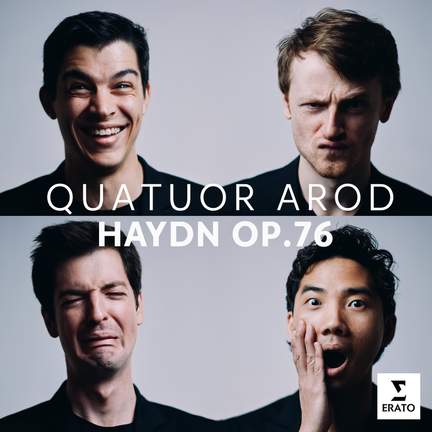
It's hard not to be captivated by the sheer inventiveness of the Arod's playing, their sense of delight in music where Haydn often seems to take himself by surprise. They are always acutely...
Special offer. Haydn: String Quartets Op. 76
Quatuor Arod
Purchase product
It's hard not to be captivated by the sheer inventiveness of the Arod's playing, their sense of delight in music where Haydn often seems to take himself by surprise. They are always acutely...
About
For Quatuor Arod, the six string quartets in Haydn’s opus 76 “represent the apogee of the Classical style, but they are also ageless, presenting almost infinite possibilities”. This is Quatuor Arod’s first Erato recording of music from the late 18th century, though the ensemble’s repertoire for the label extends from Bach chorales through Schubert, Mendelssohn, Zemlinsky, Schoenberg, Webern, Debussy and Ravel to the contemporary French composer Benjamin Attahir.
This Haydn project has been close to Arod's heart for a long time, but the players wanted to give it time to mature. “The op. 76 quartets, which were published in 1799, have long fascinated us. Composed when Haydn, the founding father of the string quartet, was in his mid-sixties, they represent him in all his maturity, achievement and mastery as he exploits a broad expressive palette, tempering depth and grandeur with humour. Haydn, who embodies so many characters, was revolutionary for his time. The works in op. 76, which reached a new level of freedom in their form, tempi and lyricism, constitute a turning point in the history of the quartet as a genre. They undoubtedly influenced Beethoven.”
The six quartets include three that carry a nickname: No. 3 is the ‘Emperor’ (its second movement comprises variations on the famous melody that became the national anthem of Austria-Hungary), No. 4 is the ‘Sunrise’, and No. 2 is the ‘Fifths’. The first of the set, which is in G major, has played a determining role in the history of the Quatuor Arod. “It was one of the first works we played, and it has provided a foundation and inspiration since then. Having fallen in love with the first quartet of op. 76 we naturally went on to explore other Haydn opuses, notably numbers 20, 33 and 74, but before long we set our minds on deepening our relationship with the entirety of op. 76. We were fascinated by its inventiveness and richness, so we played each of the quartets separately, several times over several seasons, before venturing to record them.”
In exploring this Classical repertoire, the Arod’s players sought “to play in a way that was faithful to both the spirit and letter of these works. This led us to reconsider certain fundamental choices, notably our choice of bow. The modern bow, invented after the time of Haydn – who was himself a violinist – did not allow us enough flexibility and lightness, which are defining features of his writing …” This situation led the quartet to commission a new set of bows, based on models produced in the 1770s by the celebrated bow-maker brothers François-Xavier and Léonard Tourte. “The impact of the Classical bows was immediate: the articulation became more natural, the responses more flexible, the sound more transparent. They transformed our way of playing, which became lighter, more open and more free.
“Our instruments date from the 17th and 18th centuries, so they were probably already being played when Haydn’s op. 76 was published. That being said, the Arod’s identity derives from a diversity of repertoire, from Bach to contemporary music, which means that our instruments need to be able to respond as much to the finesse of Haydn as to the power of Bartók. For us the Classical bows represent an ideal compromise, since we have not undertaken any modifications to the modern configuration of our instruments. We use these bows for all the Classical repertoire, notably for Mozart.
“All in all, this recording of Haydn’s op. 76 quartets stands as an important landmark in our career, opening a new chapter in our way of approaching the quartet.”
Contents and tracklist
Spotlight on this release
-
An error occurred.
Try watching this video on www.youtube.com, or enable JavaScript if it is disabled in your browser.
Awards and reviews
 March 2026
It's hard not to be captivated by the sheer inventiveness of the Arod's playing, their sense of delight in music where Haydn often seems to take himself by surprise. They are always acutely responsive to harmonic flux.