The 20th Century Viola da Gamba
Matteo Malagoli, Cristina Centa, Stefano Rattini, Trento Vocal Ensemble, Laurence K. J. Feininger
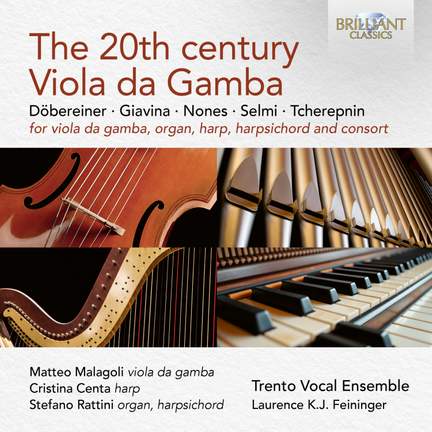
The 20th Century Viola da Gamba
Matteo Malagoli, Cristina Centa, Stefano Rattini, Trento Vocal Ensemble, Laurence K. J. Feininger
Purchase product
About
The viola da gamba is not dead, despite a claim to the contrary in the Dictionary of Musicians by German composer, organist and cellist Ernst Ludwig Gerber (1746– 1819). From the 16th century to the end of the 18th, the viola da gamba experienced a true apotheosis, becoming the favoured instrument for bourgeois entertainment, particularly in Germany, France, Italy and England, even if the instrument’s origins lie in the Spanish Renaissance. Because of these associations with the aristocracy, but also because of advances in musical style that demanded more from the role of the lower member of the string family, the gamba lost ground to the newer cello during the French Revolution. Limited interest in the instrument persisted through the 19th century, until a rebirth occurred thanks to German cellists Christian Döbereiner (1874–1961) and Paul Grüm-mer (1879–1965), and later the Austrian Karl Maria Schwamberger (1905–1967) and Swiss cellist August Wenzinger (1905–1996), a pupil of Grümmer’s and a founder, in 1925, of one of Germany’s first early music ensembles. Wenzinger was appointed cello and viola da gamba teacher at Basle’s new Schola Cantorum Basiliensis, where Giacomo Nones (1929–2017) and Jordi Savall (b.1941) would become his pupils.
Contents and tracklist
- Malagoli Matteo, Matteo Malagoli, Stefano Rattini
- Matteo Malagoli, Cristina Centa
- Matteo Malagoli, Cristina Centa
- Matteo Malagoli, Cristina Centa
- Trento Vocal Ensemble Laurence K.J. Feininger