Oskar C. Posa: Lieder, Violin Sonata, String Quartet
Juliette Journaux, Eva Zavaro, Simon Dechambre, Quatuor Métamorphoses, Edwin Fardini
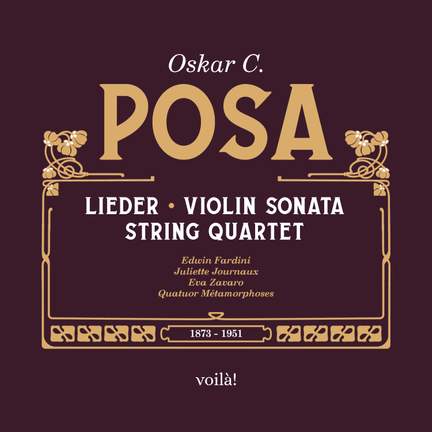
Oskar C. Posa: Lieder, Violin Sonata, String Quartet
Juliette Journaux, Eva Zavaro, Simon Dechambre, Quatuor Métamorphoses, Edwin Fardini
Purchase product
About
Oskar Posa (1873–1951) is one of music history’s greatest enigmas. An Austrian post-Romantic composer, celebrated conductor, and central figure in turn-of-the-century Vienna, his name has nonetheless faded from memory. In 1904, together with Arnold Schoenberg and Alexander von Zemlinsky, he founded the Association of Viennese Composers – the musical counterpart to Gustav Klimt’s Secession. The three friends shared the stage in 1905 at a landmark concert at the Musikverein, which premiered Posa’s Soldatenlieder, Zemlinsky’s The Little Mermaid, and Schoenberg’s Pelléas und Melisande.
His music, seductive and rich in color, merges the languages of Brahms and Wagner. In his lieder – which brought him fame across Europe and the United States – Posa astonishes with the force of his originality: from the impassioned urgency of Du hast mich to the jealous delirium of the melodrama Die Gelbe Blume, from the hypnotic urban refrain of In einer großen Stadt to the vast operatic surges of Beschwichtigung, Posa disrupts the traditional balance between voice and piano. Some even claimed his lieder were “piano compositions with vocal accompaniment.”
The premiere of his Violin Sonata in 1901 was a crushing failure: the work’s extreme technical demands, obsessive motifs and tense lyricism drew the ire of the international press. Deeply wounded, Posa ceased composing for years. Principal conductor at the Graz Opera from 1911 to 1932, then a teacher at the Vienna Conservatory, he fell into disgrace in 1938 after the Anschluss. Targeted by the Nazi regime for being Jewish, he was erased from musical life. On the eve of his death, he composed his only String Quartet – a final homage to the vanished Vienna of 1900: its poisonous perfumes, spectral waltzes, and lingering shadows.
This world premiere double album, the result of four years of research, presents 24 previously unpublished lieder, his Violin Sonata, and his String Quartet, accompanied by a richly illustrated booklet retracing the extraordinary story of this singular musician.
Contents and tracklist
- Eva Zavaro, Juliette Journaux
- Simon Dechambre, Juliette Journaux
- Quatuor Métamorphoses
- Edwin Fardini, Juliette Journaux
- Edwin Fardini, Juliette Journaux
- Edwin Fardini, Juliette Journaux
- Edwin Fardini, Juliette Journaux
- Edwin Fardini, Juliette Journaux
- Edwin Fardini, Juliette Journaux
- Edwin Fardini, Juliette Journaux
- Edwin Fardini, Juliette Journaux
- Edwin Fardini, Juliette Journaux
- Edwin Fardini, Juliette Journaux
- Edwin Fardini, Juliette Journaux
- Edwin Fardini, Juliette Journaux