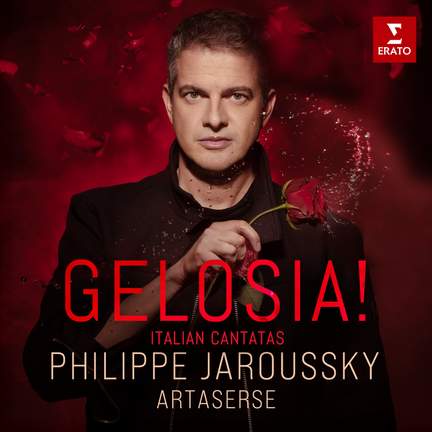
Special offer. Gelosia!
Philippe Jaroussky (countertenor/director), Artaserse
Awards:
-
Presto Recording of the Week, 24th October 2025

Jaroussky comes into his own in Vivaldi's Cessate, omai cessate (1735), especially in the fiery vengeance of the final aria 'Nell' orrido albergo'...[He] delivers spectacular coloraturas in...
Special offer. Gelosia!
Philippe Jaroussky (countertenor/director), Artaserse
Purchase product
Awards:
-
Presto Recording of the Week, 24th October 2025
Jaroussky comes into his own in Vivaldi's Cessate, omai cessate (1735), especially in the fiery vengeance of the final aria 'Nell' orrido albergo'...[He] delivers spectacular coloraturas in...
About
Gelosia! (Jealousy!), Philippe Jaroussky’s latest project with the instrumentalists of Artaserse, takes its dramatic name from two solo cantatas receiving world premiere recordings. Programmed beside cantatas by Vivaldi, Handel and Alessandro Scarlatti, they are by the Neapolitan Nicola Porpora (1686-1768) and the Venetian Baldassare Galuppi (1706-1785). Though composed some 35 years apart, both cantatas set the same text, ‘La Gelosia’, written by the prolific Pietro Metastasio.
“The cantata da camera or secular cantata, was an incredibly popular genre in the 18th century,” explains Philippe Jaroussky. “Written for a solo singer, it often portrays a man or woman going through the torments of love and depicts the character’s various states of mind … On this album we have focused on cantatas written with a string accompaniment [rather than simply for singer and basso continuo] … Cantatas of this kind often served as a laboratory for new ideas and, I believe, as a kind of personal diary for composers. Being away from opera, with its more academic demands, they could write as they wanted, completely free to express their feelings.”
When Jaroussky recorded an album of arias by Porpora as a tribute to the castrato Farinelli – the composer’s singing pupil – the Times wrote: “I’d be surprised if Farinelli’s voice was any more astonishing than the countertenor Philippe Jaroussky …” Now the singer provides some insights into both Porpora’s and Galuppi’s settings of ‘La Gelosia’.
“In Porpora’s setting, composed in 1746, there is a compact instrumental overture, which signals the cantata’s status as a work that stands as an independent entity. Porpora is at his best in accompanied recitative – this becomes clear as the protagonist expresses his regret at daring to doubt the fidelity of his mistress. He swears he will no longer be jealous, but then, in the second recitative, he reverts to form as he remembers how she blushed when she saw another man ... Porpora’s writing is very much in the galant style, characterised by florid sequences of triplets and an abundance of accents and trills. The final aria reflects the text wonderfully ... In its first section the instruments depict the sea, and in the central section they evoke the trumpets of war.
“Galuppi’s version of ‘La Gelosia’, which dates from 1782, adopts a notably different, Classical style, more concise and full of elegant detail. It moves away from florid writing and instead concentrates on textual inflections. The adagio ending of the second recitative somehow reminds me of ‘Quando corpus morietur’ from Pergolesi’s Stabat mater.”
If the ‘jealousy’ cantatas by Porpora and Galuppi represent a new discovery, Jaroussky has given frequent performances of the works by Vivaldi (‘Cessate, omai cessate’), Handel (‘Mi palpita il cor’) and Alessandro Scarlatti (‘Ombre tacite e sole’). He describes Scarlatti as “the unquestioned master” of the cantata da camera, praising ‘Cessate, omai cessate’ (dating from 1716) as “full of adventurous harmonies and haunting melodic charm”, and noting the composer’s musical evocations of splashing water, howling beasts and slithering serpents! “An absolute masterpiece among Italian cantatas”, is Jaroussky’s verdict on Vivaldi’s ‘Cessate, omai cessate’, composed around 1735. The composer’s distinctive writing for strings echoes and amplifies the emotions of the protagonist, which shift from quiet depair to raging torment. Handel’s ‘Mi palpita il cor’ was written shortly after the young composer’s extended stay in Italy in the early years of the 18th century. Its first aria includes “a sublime and very sensuous dialogue between the voice and a flute,” and, in its opening recitative, the only instance of the word ‘gelosia’ in any of the five cantatas on the album.
Contents and tracklist
Spotlight on this release
-
An error occurred.
Try watching this video on www.youtube.com, or enable JavaScript if it is disabled in your browser.
-
An error occurred.
Try watching this video on www.youtube.com, or enable JavaScript if it is disabled in your browser.
-
An error occurred.
Try watching this video on www.youtube.com, or enable JavaScript if it is disabled in your browser.
-
Philippe Jaroussky celebrates 25 years in the profession
31st Dec 2025
The French countertenor reflects on the changes he's seen during his first quarter-century in the business, his recent album of Italian secular cantatas, his blossoming parallel career as a conductor, and why he's a firm believer that 'the grass is not always greener in another field'.
-
Gelosia from Philippe Jaroussky and Artaserse
24th Oct 2025
The French countertenor does battle with the green-eyed monster in a programme of secular Italian cantatas, featuring two popular examples by Handel and Vivaldi, one relative rarity by Alessandro Scarlatti, and world premiere recordings of works by Porpora and Galuppi.


Awards and reviews
-
Presto Recording of the Week24th October 2025
 January 2026
Jaroussky comes into his own in Vivaldi's Cessate, omai cessate (1735), especially in the fiery vengeance of the final aria 'Nell' orrido albergo'...[He] delivers spectacular coloraturas in the Galuppi and serves up an expansive cadenza at the end
 24th October 2025
At 47, Jaroussky need fear no comparison with his younger self: the voice has retained all of that distinctive sweetness, clarity and flexibility which it displayed in his twenties…Slighted swains upbraiding faithless nymphs and shepherdesses are the order of the day, but there’s plenty of variety of mood and colour on offer and Ensemble Artaserse (under Jaroussky's direction) mine the expressive possibilities of the music for all their worth.