Martinů: String Quartets Nos. 2-3-5-7
Pavel Haas Quartet
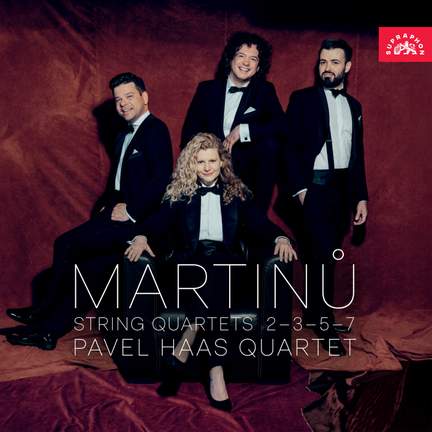
Awards:
-
Presto Recording of the Week, 19th September 2025

-
Gramophone Magazine, Awards Issue 2025, Editor's Choice

-
International Classical Music Awards, 2026, Winner - Chamber

-
Presto Recordings of the Year, Winner 2025

Starting with motoric rhythmic energy, before turning to a more lyrical second theme, [No. 5] shows two faces of Martinů's composing personality. Both are beautifully and intensely conveyed...
Martinů: String Quartets Nos. 2-3-5-7
Pavel Haas Quartet
Purchase product
Awards:
-
Presto Recording of the Week, 19th September 2025
-
Gramophone Magazine, Awards Issue 2025, Editor's Choice
-
International Classical Music Awards, 2026, Winner - Chamber
-
Presto Recordings of the Year, Winner 2025
Starting with motoric rhythmic energy, before turning to a more lyrical second theme, [No. 5] shows two faces of Martinů's composing personality. Both are beautifully and intensely conveyed...
About
Pavel Haas Quartet, one of the very top ensembles on the worldwide chamber music scene, has been devoting itself to works for string quartet by Bohuslav Martinů for a number of years and has given complete presentations of them, including a series of concerts at London’s Wigmore Hall.
Martinů’s deep affinity for the quartet genre is evident throughout his oeuvre: “I can’t tell you what pleasure I feel when working with those four voices... I somehow feel at home with the quartet, intimate, happy... Being independent, free, they do as they wish, and despite that, they create harmonious interplay, forming something, a new entity and a harmonic whole”. For this recording, they have chosen the 2nd, 3rd, 5th, and 7th quartets – four widely different worlds that together create an exciting musical arch spanning more than two decades of the 20th century. The Second String Quartet was Martinů’s breakthrough, earning himinternational attention, then in the Third the composer gave himself plenty of room for experimentation. The Fifth (Paris, 1938) is full of emotions and inner tension, while in the post-war Seventh (New York 1947), Martinů seems to have returned to Dvořákian romantic lyricism and melodiousness. In interpretations by the Pavel Haas Quartet, these works are heard with an new, unexpected intensity.
Renowned for their rich, colourful sound, fascinating interplay, and feel for details, the Pavel Haas Quartet is able not only to understand Martinů’s language, but also to communicate it convincingly and draw listeners into the inner world of one of the greatest Czech composers of the 20th century.
Contents and tracklist
Spotlight on this release
-
An error occurred.
Try watching this video on www.youtube.com, or enable JavaScript if it is disabled in your browser.
-
The Pavel Haas Quartet perform string quartets by Martinů
19th Sep 2025
Three years on from their previous recording of music by Brahms, the Czech quartet returns with a stunningly virtuosic album of four string quartets by their compatriot Bohuslav Martinů, showcasing an enormous dynamic range combined with an impressive precision and unanimity of purpose.

Awards and reviews
-
Presto Recording of the Week19th September 2025
-
Gramophone MagazineAwards Issue 2025Editor's Choice
-
International Classical Music Awards2026Winner - Chamber
-
Presto Recordings of the YearWinner 2025
 December 2025
Starting with motoric rhythmic energy, before turning to a more lyrical second theme, [No. 5] shows two faces of Martinů's composing personality. Both are beautifully and intensely conveyed here, with bright, honest sound which brings clarity to the layers of the second movement, its long sustained melody coloured by tremolo and pizzicato.
 Awards Issue 2025
While Martinů's quartets suffer less than total neglect, the present anthology could be a game-changer for a series which, the Seventh apart, gets fewer performances than it deserves.
 19th September 2025
The highlight is arguably their performance of Quartet No. 3, with the last movement containing some of the most jaw-droppingly virtuosic string playing I have heard for some time. It's not just the crispness of their ensemble playing at the eye-wateringly breakneck tempo they adopt (which, as fast as it is, almost implausibly gets even faster in the piece's final pages), but the fact that amidst this maelstrom of notes they also manage to inject dynamics, accents and a shaping of phrases that is quite extraordinary.