Special offer. Honegger: Petite Chapelle Songs
Eleni Lydia Stamellou (soprano), Alexandra Listova (piano)
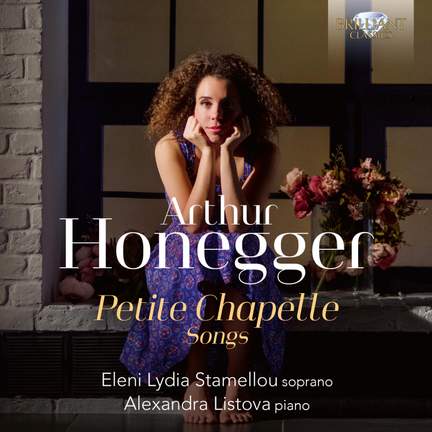
Special offer. Honegger: Petite Chapelle Songs
Eleni Lydia Stamellou (soprano), Alexandra Listova (piano)
Purchase product
About
Arthur Honegger's song output falls into two distinct periods. The first spans his apprentice years from 1914 – the date of the first of the 4 Poèmes H.7 – to 1924. He returned to art song on the eve of the Second World War, and Eleni-Lydia Stamellou sings two further sets of songs originally conceived as film accompaniments.
In the 4 Poems there is a Debussian turn to the harmony which mirrors the symbolist flavor of the text. More distinct from the model of Debussy is the album's title track, 'Petite Chapelle', with its avowedly spiritual character. Honegger conceived his 3 Poèmes de Paul Fort in the autumn of 1916. Here the relationship between music and text is more directly illustrative, as in the distant hunting horns to accompany the hunter lost in the forest. From February 1917, Nature morte stands alone as a musical still-life, a brief sketch of a bowl of peaches and white grapes. No less epigrammatic, but more musically adventurous as befitting the text, are Honegger's settings of the 6 Poèmes d'Apollinaire which he composed between August 1915 and March 1917. But, for all Apollinaire's influence over the composers of 'Les Six' – Honegger included – Jean Cocteau was far more instrumental in determining their aesthetic aims. And though it was Apollinaire who had coined sur-réalisme in response to seeing the premiere of Satie's ballet Parade in 1917, this new, mischievous spirit courses through Honegger's deft settings of Cocteau. Honegger makes a sincere tribute to one of France's most celebrated Renaissance-era poets in the Chanson de Ronsard from February 1924. From 1926, the 3 Chansons de La Petite Sirène feature whole-tone rising harmonies in the opening song, and the even briefer companions uphold a Satie-like inscrutability.
At this point, Honegger continued in vocal music (operas, operettas and oratorios) but left song alone. However, in 1937, his soundtrack to Jean Choux's 'talkie' remake of Louis Mercanton's 1920 silent film Miarka, la fille à l'ourse afforded an opportunity to write two brief songs. Eleni Lydia Stamellou's recital closes with another pair of songs written for the cinema, the Romances sentimentales for Un seul amour, a story by Balzac very loosely adapted for the screen by Pierre Blanchar. In a genre all their own are the settings of 3 Psaumes, which Honegger composed in occupied Paris over the winter of 1940/1. The sound of the organ underpins the Bachian flow accompanying Psalm 34 and the misty F minor chords beneath Psalm 140, even if the vocal line itself harks back to Honegger's song-writing of the 1920s.
Contents and tracklist
- Eleni Lydia Stamellou, Alexandra Listova
- Eleni Lydia Stamellou, Alexandra Listova
- Eleni Lydia Stamellou, Alexandra Listova
- Eleni Lydia Stamellou, Alexandra Listova
- Eleni Lydia Stamellou, Alexandra Listova
- Eleni Lydia Stamellou, Alexandra Listova
- Eleni Lydia Stamellou, Alexandra Listova
- Eleni Lydia Stamellou, Alexandra Listova
- Eleni Lydia Stamellou, Alexandra Listova
- Eleni Lydia Stamellou, Alexandra Listova