Schneider: 4 Flute Sonatas
Daniele Ruggieri (flute), Luigi Caselli (piano)
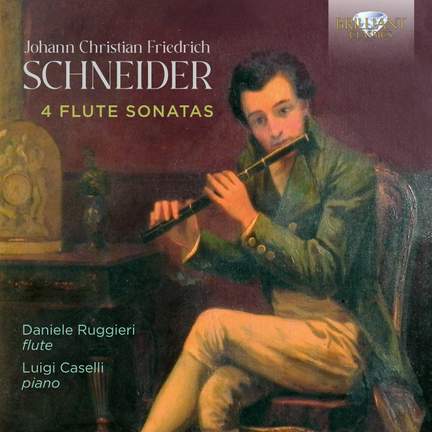
Schneider: 4 Flute Sonatas
Daniele Ruggieri (flute), Luigi Caselli (piano)
Purchase product
About
World premiere recordings of beguiling flute sonatas written on the cusp of the early-Romantic era in Germany.
Almost completely forgotten in our own time, Johann Christian Friedrich Schneider (1786-1853) once enjoyed substantial fame as a pianist, composer, teacher, and musical organiser. He was born in 1786, 16 years after Beethoven, in the same year as Weber and the Brothers Grimm, and received his first musical education from his father. His talent was evident from an early age, as he learned the piano and several other instruments. Breitkopf & Hartel published his Op.1, a set of piano sonatas, in 1804; he went to study in Leipzig, where he became organist of the Thomaskirche, and settled there for his 20s, giving the local premiere of Beethoven's 'Emperor' Concerto in 1811.
A standard German work of reference from 1838 cites Schneider 'among the living German masters of music'. From the evidence of these four sonatas for flute and piano, it is hard to see why his name should have so comprehensively vanished from view. Schneider composed the first of them, his Op.18, in 1808, and it follows the same Classical exemplar as Beethoven's first eight violin sonatas, and all of Mozart's in being written for a pianist with an accompanying melody instrument rather than the other way around. Over the course of the following three sonatas, the flautist becomes more independent, and his Op.61 Sonata of 1827 requires a virtuoso.
Schneider wrote the first three sonatas in a four-movement form, breaking ground in this way by elevating the flute sonata from its previous association with pretty variation sets and pot-pourris of operatic themes. This originality extends to the finales of all four sonatas – notably the Second, which is cast in G minor against the prevailing G major tonality (foreshadowing in this way the 'Italian' Symphony of Mendelssohn). In his booklet essay for this new recording, the flautist Daniele Ruggeri pays tribute to the 'simple but bewitching' trios of each sonata, and to Schneider's 'profound understanding of the expressive character of the different registers of the flute' in the slow movements. Based in Venice, Ruggeri has played across the world and recorded for many major labels. With this album of Schneider, he revives an unjustly neglected contemporary of Beethoven and Schubert, and does so on an instrument of the period.
Contents and tracklist
- Daniele Ruggieri, Luigi Caselli
- Daniele Ruggieri, Luigi Caselli
- Daniele Ruggieri, Luigi Caselli