Stanley: Voluntaries Op.5-7
Pietro Delle Chiaie (organ)
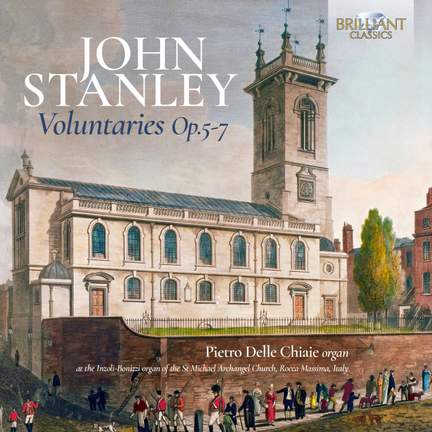
Stanley: Voluntaries Op.5-7
Pietro Delle Chiaie (organ)
Purchase product
About
John Stanley was born in London on 17 January 1712. A precocious musician, by the age of nine he was playing the organ (probably as an occasional deputy) at All Hallows, Bread Street.
When the titular organist there – the composer and harpsichordist William Babell, a former pupil of Handel – died on 23 September 1723, an eleven-year-old Stanley was appointed in his place. At the age of 14, he was chosen as organist at St. Andrew's, Holborn, and at the age of 17 became the youngest person ever to obtain the BMus degree from Oxford University. In 1734, he was appointed organist to the Society of the Inner Temple, a position he held until his death.
As a musician whose primary responsibilities were liturgical, John Stanley was required to accompany the service music every Sunday, and also to improvise volunteers at various points in the service. A voluntary was a piece improvised extemporaneously and, prior to the 19th century, in the Church of England there were two principal forms of voluntary. These were a First Voluntary – generally an introduction and a movement or two for solo stops such as the trumpet or cornet – placed between the psalms and the first lesson at Morning and Evening Prayer, and a Second Voluntary – generally an introduction and fugue – at the end of the service. John Stanley's primary responsibility in his sixty-three years as organist at these various churches was to improvise a voluntary before the first lesson (comprising an introduction and an additional movement or two for the solo stops) and an introduction and fugue at the end of the service. Stanley's improvisations were reportedly so fine that on Sundays none other than Handel himself, who attended St. George's, Hanover Square, would sometimes leave church early and rush over to the Temple Church to hear Stanley's final voluntary.
Most volunteers were never written down as compositions, and very few volunteers for organ were published in England before Stanley's Op. 5 of 1748. But written-out volunteers did serve two main purposes: first, they were often used for recital purposes, as for example when organists like Stanley played at the dedication of a new instrument; second, they were widely used as exercises for apprentices or organ students, or for church organists new to their roles. Some of the manuscript collections produced for this purpose have survived. One important collection of this kind is the so-called Southgate Manuscript, a collection of 64 volunteers in the library of the Royal College of Organists in London. This seems to have been compiled around the year 1750 in order to instruct choristers of the Chapel Royal who were learning the organ. This manuscript contains several of the early organ works of John Stanley.