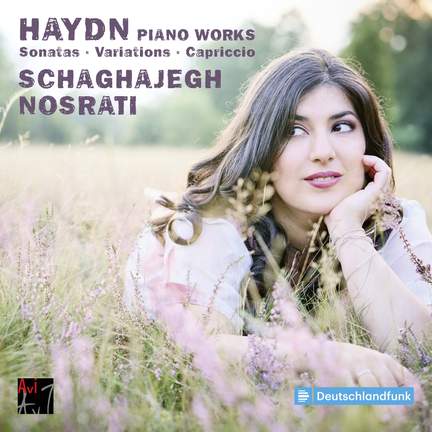
Special offer. Haydn: Piano Works
Schaghajegh Nosrati (piano)
Her reading of the whole movement [the opening of Hob.XVI:52] abounds in sharp yet never overstated dynamic contrasts and a feeling of urbane exuberance. She shapes the central slow movement...
Special offer. Haydn: Piano Works
Schaghajegh Nosrati (piano)
Purchase product
Her reading of the whole movement [the opening of Hob.XVI:52] abounds in sharp yet never overstated dynamic contrasts and a feeling of urbane exuberance. She shapes the central slow movement...
About
Joseph Haydn was one of the first composers who devoted himself writing sonatas for piano, a format which was just developing in the early 18th century.
Within 50 years, he had composed more than 50 Piano sonatas. This musical format was developed by Mozart, Beethoven, and later also Schubert. The piano sonatas are taking a large proportion of those composers and is still a major favoured format in the concert world.
"No one else can do everything, jest and shock, create laughter and profound emotion, as Haydn can, and no one can do everything as well as Haydn can." Those were the terms in which Wolfgang Amadeus Mozart praised his older colleague Joseph Haydn, with whom he remained close friends until the end of his life. It would be hard to find a better description of this music. Humour was an essential part of Haydn's musical language, but also of his character - at least if we are to believe the account of his contemporary Albert Christoph Dies, whose biography is based on conversations with the (already very elderly) composer: "Haydn explained that this was 'a character trait of his that once came from an abundance of health... One is seized by a certain humour that cannot be tamed.' "
However, reading this oldest biography of Haydn also gives us an idea that behind the cheerful, almost naive facade lies a complex personality with a strong tendency towards melancholy and depression. Like every great composer, Haydn also looked into the abyss, especially in the later years of his life, when he suffered from increasing physical infirmity. The selection on this CD is a cross-section of the composer's successive creative phases. Haydn composed keyboard music over about four decades (ca. 1755-1796). In his day, the word "Clavier" was used as a generic term for various keyboard instruments that coexisted, namely the harpsichord, the clavichord, and the fortepiano (Hammerflugel). Depending on availability and purpose, either instrument was used. The clavichord was considered the best instrument for students to learn to play with nuances, and Haydn composed mainly on the clavichord. ....... Although on this recording I have decided to record all works on a modern grand piano, I found it important to take into account which instruments these pieces were intended for when deciding on matters of interpretation and performance. (Schaghajegh Nosrati)
Contents and tracklist
- Schaghajegh Nosrati (piano)
- Recorded: 2023-09
- Recording Venue: Deutschlandfunk Kammermusiksaal, Köln
- Schaghajegh Nosrati (piano)
- Recorded: 2023-09
- Recording Venue: Deutschlandfunk Kammermusiksaal, Köln
- Schaghajegh Nosrati (piano)
- Recorded: 2023-09
- Recording Venue: Deutschlandfunk Kammermusiksaal, Köln
- Schaghajegh Nosrati (piano)
- Recorded: 2023-09
- Recording Venue: Deutschlandfunk Kammermusiksaal, Köln
- Schaghajegh Nosrati (piano)
- Recorded: 2023-09
- Recording Venue: Deutschlandfunk Kammermusiksaal, Köln
Spotlight on this release
-
An error occurred.
Try watching this video on www.youtube.com, or enable JavaScript if it is disabled in your browser.
Awards and reviews
 August 2025
Her reading of the whole movement [the opening of Hob.XVI:52] abounds in sharp yet never overstated dynamic contrasts and a feeling of urbane exuberance. She shapes the central slow movement with a refulgent finger legato that mostly renders the sustain pedal superfluous.