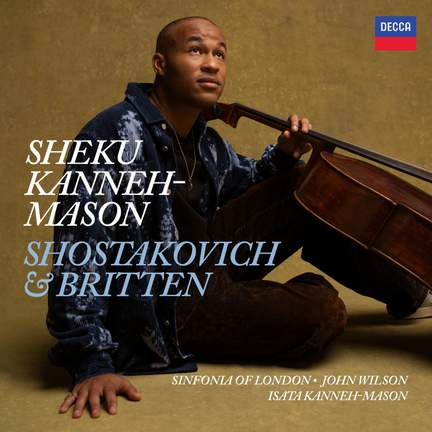
Shostakovich: Cello Concerto No. 2; Britten: Cello Sonata
Sheku Kanneh-Mason (cello), Sinfonia of London, John Wilson, Isata Kanneh-Mason (piano)
Awards:
-
Gramophone Magazine, June 2025, Editor's Choice

Sheku Kanneh-Mason states that he has played [the Shostakovich sonata] since his teenage years, and his affinity with its melodic phrases and emotional tenor is well formed. He brings a lovely...
Shostakovich: Cello Concerto No. 2; Britten: Cello Sonata
Sheku Kanneh-Mason (cello), Sinfonia of London, John Wilson, Isata Kanneh-Mason (piano)
Purchase product
Other available formats

Awards:
-
Gramophone Magazine, June 2025, Editor's Choice
Sheku Kanneh-Mason states that he has played [the Shostakovich sonata] since his teenage years, and his affinity with its melodic phrases and emotional tenor is well formed. He brings a lovely...
About
Decca Classics proudly announces Shostakovich & Britten, the new album from internationally acclaimed cellist Sheku Kanneh-Mason, set for release on 9th May 2025. Featuring Shostakovich’s Cello Concerto No. 2, performed with John Wilson and the Sinfonia of London, alongside the cello sonatas of Shostakovich and Britten, this deeply personal recording pays tribute to cellist Mstislav Rostropovich, the towering figure who inspired both composers—and Kanneh-Mason himself.
Sheku Kanneh-Mason has a long-standing connection and affinity to Rostropovich and Shostakovich. His 2018 debut album, Inspiration, featured Shostakovich’s First Cello Concerto —the piece that secured his victory at the 2016 BBC Young Musician competition and launched his international career. The album made chart history, making him the youngest cellist ever, at 18 years old, to break into the Top 20 of the UK Official Album Chart. Now, seven years later, he returns to the composer’s music with Cello Concerto No. 2, an introspective masterpiece composed for Rostropovich in 1966, and the Sonata in D minor, written in 1934 for Viktor Kubatsky. “This concerto is a piece I’ve loved and studied for a long time,” Kanneh-Mason reflects. “It contains some of the most beautiful and sweetest moments in music, as well as some of the darkest and bleakest. To have all of that within one piece is very powerful.”
Sheku Kanneh-Mason’s performance captures the raw vulnerability and unrelenting depth of Shostakovich’s writing. Reflecting on the recording process, he recalls: “It was very intense spending seven hours in a world of emotions that have a genuine effect on me. John is always searching for more, and the orchestra was invested in every note, which is really the dream for this piece.”
Contents and tracklist
- Sheku Kanneh-Mason (cello)
- Sinfonia of London
- John Wilson
- Recorded: 2024-10-17
- Recording Venue: St. Augustine's, Kilburn, London
- Sheku Kanneh-Mason (cello), Isata Kanneh-Mason (piano)
- Recorded: 2024-11-04
- Recording Venue: Snape Maltings Concert Hall, Suffolk
- Sheku Kanneh-Mason (cello), Isata Kanneh-Mason (piano)
- Recorded: 2024-11-04
- Recording Venue: Snape Maltings Concert Hall, Suffolk
Awards and reviews
-
Gramophone MagazineJune 2025Editor's Choice
 July 2025
Sheku Kanneh-Mason states that he has played [the Shostakovich sonata] since his teenage years, and his affinity with its melodic phrases and emotional tenor is well formed. He brings a lovely unaffected melodic flow to the opening movement with a sombre and reflective intensity in the Largo.
 June 2025
The uniqueness of the present coupling is hardly the least of its assets. With sound of unfailing definition and focus, it demonstrably takes Kanneh-Mason’s standing on to a whole new level.
 9th May 2025
Placed alongside the extreme polish of Yo-Yo Ma’s Boston account, recently reviewed, Kanneh-Mason’s more darkly coloured, less manicured approach has definite advantages. Yet the music on the album that really takes off is not the concerto but Shostakovich’s Cello Sonata of 1934, the wider, more flamboyant emotional range of which better suits Sheku’s romantic instincts.