Special offer. Brahms & Contemporaries, Vol. 2
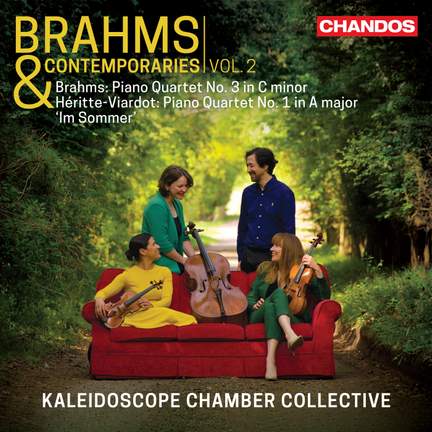
Brahms: Piano Quartet No. 3 & Héritte-Viardot: Piano Quartet No. 1 'Im Sommer'
Kaleidoscope Chamber Collective
If you like your Brahms Third Quartet rich, dark and wide, then you might not make immediate friends with this one, but I’ve appreciated its lighter, lucid, nervily choppy angst...So an instantly...
Special offer. Brahms & Contemporaries, Vol. 2
Brahms: Piano Quartet No. 3 & Héritte-Viardot: Piano Quartet No. 1 'Im Sommer'
Kaleidoscope Chamber Collective
Purchase product
If you like your Brahms Third Quartet rich, dark and wide, then you might not make immediate friends with this one, but I’ve appreciated its lighter, lucid, nervily choppy angst...So an instantly...
About
Brahms’s Third Piano Quartet gestated for a long time – the first sketches were made in 1855, whilst the work was not completed until 1875.
Numerous commentators tie the work to Brahms’s infatuation with Clara Schumann, who certainly heard many of the various iterations of the piece before its final version. But Brahms did not write programme music, and whatever his motivations may or may not have been, the result is, like the rest of his output, pure music.
Louise Héritte-Viardot was a French singer, pianist, conductor, and composer. She was born in Paris, the eldest child of Pauline Viardot-Garcia and Louis Viardot, and sister to the violinist and conductor Paul Viardot. Her singing career was cut short by illness, but with the help of Clara Schumann she found a second career as a singing teacher at the Hoch Conservatory, in Frankfurt.
In contrast to Brahms’s quartet, Viardot’s work is extremely programmatic. Titled Im Sommer (In Summer), it comprises four movements which also carry evocative titles: ‘Morning, in the Woods’, ‘Flies and Butterflies’, ‘Sultriness’, and ‘Evening, under the Oak-tree’.
Contents and tracklist
Awards and reviews
 July 2025
If you like your Brahms Third Quartet rich, dark and wide, then you might not make immediate friends with this one, but I’ve appreciated its lighter, lucid, nervily choppy angst...So an instantly winsome unknown, followed by a Brahms to challenge our expectations. Who can argue with that?