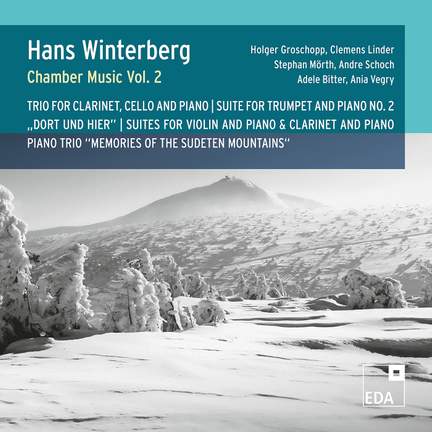
Winterberg: Chamber Music, Vol. 2
Holger Groschopp (piano), Stephan Mörth (clarinet), Adele Bitter (cello), Clemens Linder (violin), Andre Schoch (trumpet), Ania Vegry (soprano)
This bridge between Western, Central and Eastern European musical elements results in an astonishing and unpredictable diversity of styles vividly reflected in this fascinating and adeptly performed...
Winterberg: Chamber Music, Vol. 2
Holger Groschopp (piano), Stephan Mörth (clarinet), Adele Bitter (cello), Clemens Linder (violin), Andre Schoch (trumpet), Ania Vegry (soprano)
Purchase product
This bridge between Western, Central and Eastern European musical elements results in an astonishing and unpredictable diversity of styles vividly reflected in this fascinating and adeptly performed...
About
Hans Winterberg, born in Prague in 1901, studied with Alexander von Zemlinsky and Alois Hába. He worked as a conductor, pianist and composer until the annexation of the Czechoslovak Republic by Nazi Germany in 1939. As the scion of a Jewish family that had lived in Prague for centuries, he survived - after forced labor and deportation to Theresienstadt - through a series of miracles. After the Communists came to power in Czechoslovakia, he moved to Germany. His compositional legacy, locked away for years in a German music archive, has only been rediscovered in recent years. Winterberg combines various influences in his music to create an original and exciting personal style. He takes up stylistic elements of Janáček but is also influenced by the Second Viennese School and French Impressionism. He saw himself as a bridge-builder between the cultures of Eastern and Western Europe. eda records dedicates a focus to this important Czech-Jewish composers of the generation of the so called “Terezin composers” alongside Ullmann, Krása and Haas. Further chamber music recordings and the complete works for piano with pianist Jonathan Powell will follow.
Contents and tracklist
Awards and reviews
 June 2025
This bridge between Western, Central and Eastern European musical elements results in an astonishing and unpredictable diversity of styles vividly reflected in this fascinating and adeptly performed collection of chamber works composed between 1936 and 1964.