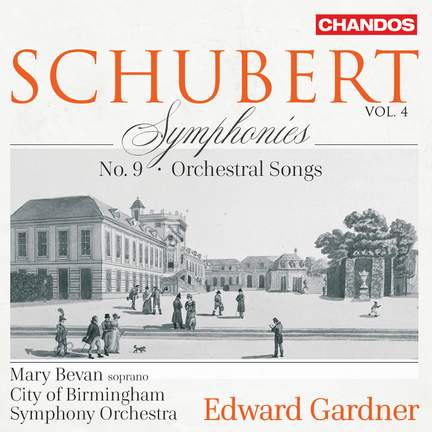
Franz Schubert: Symphonies, Vol. 4
Mary Bevan (soprano), City of Birmingham Symphony Orchestra, Edward Gardner
Gardner takes a fairly traditional view of the Ninth Symphony, making an accelerando at the end of its slow introduction to gain the tempo of the main Allegro, and applying the brakes when the...
Franz Schubert: Symphonies, Vol. 4
Mary Bevan (soprano), City of Birmingham Symphony Orchestra, Edward Gardner
Purchase product
Gardner takes a fairly traditional view of the Ninth Symphony, making an accelerando at the end of its slow introduction to gain the tempo of the main Allegro, and applying the brakes when the...
About
Edward Gardner’s Schubert cycle concludes with the ‘Great’ Symphony No. 9 in C major. Having (remarkably) composed a symphony a year between 1813 and 1818, the onset of syphilis and its intrusive treatment seemed to shake the composer’s confidence as a symphonist – the Ninth is the only symphony after those first six that he actually completed. This is attributed by many to a wonderful holiday with friends in the high Austrian Alps that seems to have re-ignited his enthusiasm. The nickname ‘Great’ may originally have arisen to distinguish it from the ‘little’ C major Symphony (No. 6), but is apt, as the Ninth is on so much greater a scale than any symphony before it, which can run to almost an hour in some performances. The soprano Mary Bevan joins Edward Gardner and the CBSO in a selection of orchestral songs that complete the album. One was orchestrated by Schubert himself, the others are settings by Britten, Berlioz, Brahms, and Reger.
Spotlight on this release
-
An error occurred.
Try watching this video on www.youtube.com, or enable JavaScript if it is disabled in your browser.
Awards and reviews
 April 2025
Gardner takes a fairly traditional view of the Ninth Symphony, making an accelerando at the end of its slow introduction to gain the tempo of the main Allegro, and applying the brakes when the introduction’s theme comes back right at the end in order to lend the moment a feeling of grandeur.
 April 2025
Overall, Gardner’s account aligns with his approach to Schubert’s preceding symphonies, balancing a sense of drama with textural clarity and a measured architectural vision.