Changes - String Octets
Roctet
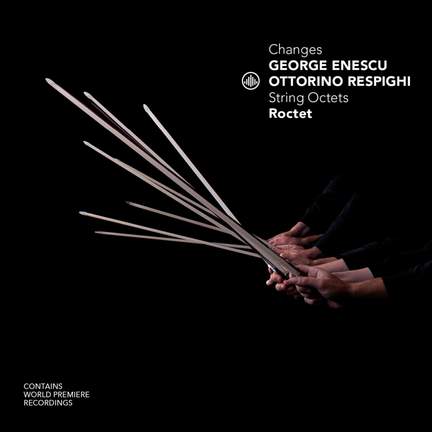
The two [composers] evidently had very different outlooks, with Respighi bathing in late-Romanticism while Enescu’s more sparely scored, folk-inf lected work looks more to the future. Both are...
Changes - String Octets
Roctet
Purchase product
The two [composers] evidently had very different outlooks, with Respighi bathing in late-Romanticism while Enescu’s more sparely scored, folk-inf lected work looks more to the future. Both are...
About
Roctet proposes two String Octets both composed in the same year, 1900. The 18 year old Enescu brings fragments of his Romanian background and Viennese and French musical upbringing together into a unity and thus draws us into his inner world. The 21 year old Respighigoes the other way: he becomes the filmmaker with the dramatic flair of capturing beautiful images in music.
It is the year 1900: the new century has just started when two young composers independently from each other publish new additions to the string octet literature.The Romanian George Enescu at the tender age of eighteen already has gathered more musical experience than most musicians twice his age.As a composer he sets himself a complex and daunting task: his octet is in four movements, yet played together they reveal a sonata form (a structure applied to the first movements of some famous symphonies), consisting of an exposition, a development and a recapitulation.The sonata form with its statements and contrasting statements is like a dramatic monologue with arguments and counter-arguments: the young Enescu, with his formal experiment, brings fragments of his Romanian background and Viennese and French musical upbringing together into a unity and thus draws us into his inner world.
In contrast, the twenty-one year old Ottorino Respighi rather goes the other way: he becomes the observer, the filmmaker with the dramatic flair of capturing beautiful images in music, just as he would later do with equal conviction in works like Pini di Roma or Feste romane.
Contents and tracklist
Awards and reviews
 April 2025
The two [composers] evidently had very different outlooks, with Respighi bathing in late-Romanticism while Enescu’s more sparely scored, folk-inf lected work looks more to the future. Both are admirably played.
 March 2025
Roctet give a terrific performance of the Enescu. Their collective sound is on the lean side, which allows for exceptional transparency in such richly intricate music.