Clive Osgood: Stabat Mater
Grace Davidson (soprano), Jack Liebeck (violin), Mark Wilde, Julian Empett, Royal Holloway Choir, London Mozart Players, Rupert Gough
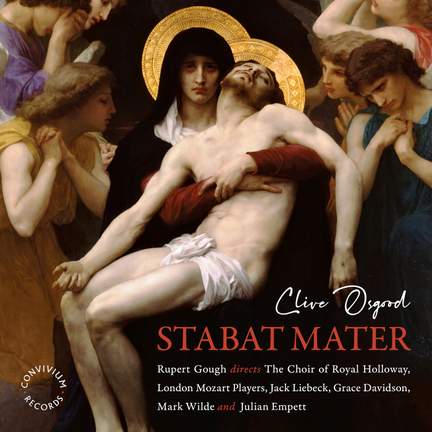
From the spine-tingling opening string refrain, you know you’re in for something special. Clive Osgood’s 2009 take on Mary's grief at Christ's Crucifixion is suitably sobering and intense when...
Clive Osgood: Stabat Mater
Grace Davidson (soprano), Jack Liebeck (violin), Mark Wilde, Julian Empett, Royal Holloway Choir, London Mozart Players, Rupert Gough
Purchase product
From the spine-tingling opening string refrain, you know you’re in for something special. Clive Osgood’s 2009 take on Mary's grief at Christ's Crucifixion is suitably sobering and intense when...
About
This setting of the Stabat Mater, a 13th century hymn to the Virgin Mary, is written for soprano, tenor and bass soloists as well as chorus, strings and piano. The work was composed in 2009 and divides the original twenty stanzas of the text into ten movements. It describes the grief-stricken Mother of Jesus standing at the foot of cross, on which he is suffering an agonising death. The overall shape of these movements provides something of an arch structure, with similar music at the beginning and end. Similarly, a slower variation of the second movement is used for the penultimate movement.
Contents and tracklist
- Grace Davidson, Jack Liebeck, Mark Wilde, Julian Empett
- Royal Holloway Choir, London Mozart Players
- Rupert Gough
Awards and reviews
 April 2025
From the spine-tingling opening string refrain, you know you’re in for something special. Clive Osgood’s 2009 take on Mary's grief at Christ's Crucifixion is suitably sobering and intense when it needs to be, but there’s a beauty, dynamism and freshness which makes this really very appealing.
 April 2025
His style is attractive and accessible, displaying a lucid ear for melody and a strong harmonic grasp, bathed in sumptuous string orchestra accompaniment with the composer himself at the piano. Think of Karl Jenkins’s capacity for earworms, combined with the delicacy of Fauré and the harmonic palette of Rutter.