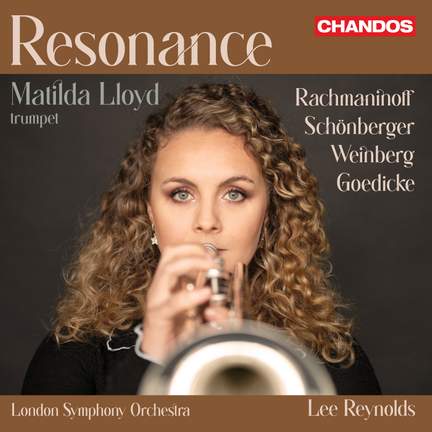
Resonance
Matilda Lloyd (trumpet), London Symphony Orchestra, Lee Reynolds
Her connection to the often elusive spirit of the score is evident right from the start, where she turns the obsessively repeating five-note runs into insouciant sneers. And Lloyd and conductor...
Resonance
Matilda Lloyd (trumpet), London Symphony Orchestra, Lee Reynolds
Purchase product
Her connection to the often elusive spirit of the score is evident right from the start, where she turns the obsessively repeating five-note runs into insouciant sneers. And Lloyd and conductor...
About
Matilda Lloyd writes: ‘Resonance is a multi-faceted word with many different meanings, all of which are explored in this album of music for trumpet and orchestra. It stems from the Latin word resonantia, meaning ‘echo’, and both concertos on this album echo music of the past. Weinberg’s Trumpet Concerto contains many fanfares that hark back to the trumpet’s military beginnings, and in the extended cadenza at the opening of the third movement, Weinberg includes snippets of music by other composers, including Mahler’s Fifth Symphony, Mendelssohn’s ‘Wedding March’, and Stravinsky’s Pétrouchka. However, these are not flippant references to the past, but rather euphemisms; Weinberg twists and distorts the quotations into something dark and menacing. Christoph Schönberger has described his Concerto as ‘neo-romantic’, drawing upon the harmonic and melodic language of composers from the romantic period. ‘Resonance’ can also be used to describe the powerful images, feelings, or memories that are conjured up in the mind upon listening to music.
Rachmaninoff’s Vocalise is the ultimate expression of this kind of resonance. The final work on the disc, Goedicke’s Concert Étude, holds a personal resonance: it was my favourite work for trumpet and piano when I was growing up. At the start of my career, it was my preferred encore and now I am thrilled to have this brand-new orchestral arrangement by Lee Reynolds.’
Contents and tracklist
Spotlight on this release
-
An error occurred.
Try watching this video on www.youtube.com, or enable JavaScript if it is disabled in your browser.
Awards and reviews
 January 2025
Her connection to the often elusive spirit of the score is evident right from the start, where she turns the obsessively repeating five-note runs into insouciant sneers. And Lloyd and conductor Lee Reynolds take Weinberg at his word, hitting the metronome mark (minim=152) on the nose to produce a sense of manic urgency that feels exactly right.