Ten Holt: Meandres
Polo de Haas (piano), Kees Wieringa (piano), Ellen Dijkhuizen (piano), Fred Oldenburg (piano)
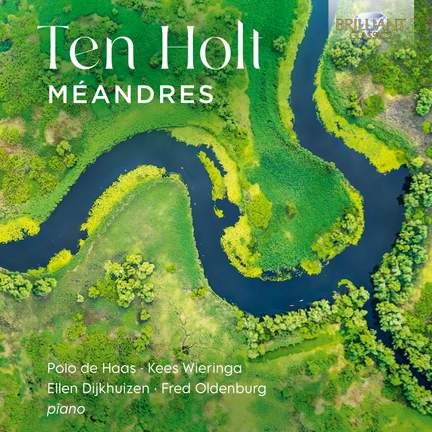
Ten Holt: Meandres
Polo de Haas (piano), Kees Wieringa (piano), Ellen Dijkhuizen (piano), Fred Oldenburg (piano)
Purchase product
About
A mesmerising piano cycle by the master of Dutch minimalism.
‘I write music like this not because I’m isolated,’ Simeon Ten Holt once said. ‘I’m isolated because I write music like this.’ And yet, since his death in 2012, performances and recordings of his music have multiplied like one of his motivic cells, gathering energy and momentum to spread the reputation of a composer who took the rhythmic precepts of American minimalists such as Reich and Glass, and coloured them with a European-Romantic glow of harmony.
Composed in 1995-97 for four pianos, Méandres is another monumental yet approachable piano cycle in the mould of his celebrated Canto Ostinato, more complex and more chromatic than the earlier cycle but sharing with it a hypnotic clarity and an improvisatory freedom which leaves a good deal of liberty to the performers. At first, there is no melody, in the usual sense of the word. However, over time, a pattern emerges like a puzzle taking shape before the listener.
The title refers to the meandering course of rivers, which takes them to mountain slopes as well as lowlands. ‘Because it is like a work in progress which never reaches closure,’ remarks the composer, ‘the meandering structure of the piece is quite demanding on the performers. It is the condensation of an inquiry into the very limits of time and space.’
This recording of Méandres was made in 1999 by a team of Dutch pianists who had all worked with Ten Holt on his music, and accordingly it vibrates with disciplined authenticity. Sharp accents continually break and articulate the line and the restatement of the germinal motif, but it always loops back to a cadence which Robert Schumann would have recognised. Combining Baroque rigour with early-Romantic harmony and late-20th-century form, Méandres is both post-modern and timeless as an extension of piano literature.
Contents and tracklist
- Polo de Haas, Kees Wieringa, Ellen Dijkhuizen, Fred Oldenburg