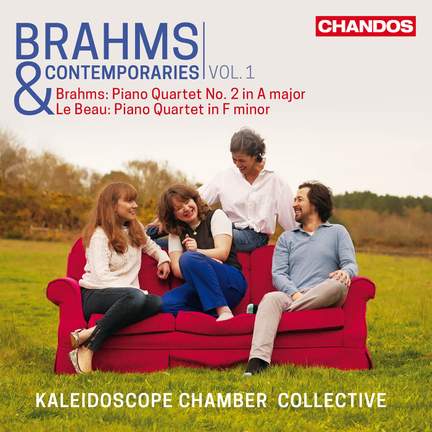
Special offer. Brahms & Contemporaries, Vol. 1
Kaleidoscope Chamber Collective (chamber ensemble)
[Le Beau's Piano Quartet] provides ample evidence of her gifts, demonstrating both a skilful handling of the medium and some instantly memorable ideas…I need hardly add that the Kaleidoscope...
Special offer. Brahms & Contemporaries, Vol. 1
Kaleidoscope Chamber Collective (chamber ensemble)
Purchase product
[Le Beau's Piano Quartet] provides ample evidence of her gifts, demonstrating both a skilful handling of the medium and some instantly memorable ideas…I need hardly add that the Kaleidoscope...
About
In this new series, the Kaleidoscope Chamber Collective juxtaposes piano quartets by Brahms with ones by his lesser-known contemporaries. For this first volume the group has chosen the piano quartet of Luise Adolpha Le Beau. Born in 1850 in Rastatt, in Baden, she studied with Clara Schumann and Franz Lachner, as well as Josef Rheinberger. Her extensive output covers all genres: orchestral works, plenty of choral music, two operas, and an extensive number of Lieder, solo piano pieces, and chamber music. Her Piano Quartet was composed in 1884 and performed in the Leipzig Gewandhaus that year to great critical acclaim; indeed, Julius Riedel, who was responsible for concerts in that venue, told her that her success eclipsed any he had known there. On a concert tour to Vienna in the same year, she met Brahms and Hanslick; both invited her to show them her compositions, and responded positively. Brahms’s Piano Quartet No. 2 was completed in 1861, and is noted for the strong influence of Schubert. Lasting almost fifty minutes, it is one of the most substantial piano quartets in the repertoire.
Contents and tracklist
Awards and reviews
 July 2024
[Le Beau's Piano Quartet] provides ample evidence of her gifts, demonstrating both a skilful handling of the medium and some instantly memorable ideas…I need hardly add that the Kaleidoscope Chamber Collective delivers a compelling and totally committed interpretation…Their performance of the Brahms is also extremely fine.
 June 2024
This light-fingered and harmonically attentive reading makes a strong argument for an unknown work.