Daryl Runswick: Four Nocturnes, Viola Sonata
National Symphony Orchestra Chamber Ensemble, Ben Parry, Caleb Sibley, Aleksander Szram, London Voices
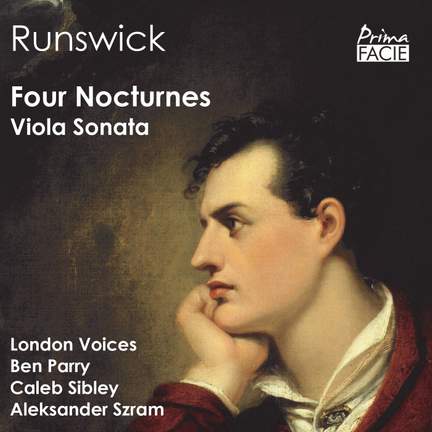
Daryl Runswick: Four Nocturnes, Viola Sonata
National Symphony Orchestra Chamber Ensemble, Ben Parry, Caleb Sibley, Aleksander Szram, London Voices
Purchase product
Other available formats

About
Runswick: "I wrote Four Nocturnes in 1992-3, a commission from The Wooburn Singers of High Wycombe, England, and their conductor Stephen Jackson. The first performance was given an ovation, the choir took it on tour to St John's, Smith Square in London, and the work continues to have a life, culminating in this recording. I dedicated Four Nocturnes to the late Dr Peter Cochran. The texts are taken from his complete edition of Byron. Four Nocturnes contains settings of Byron's night poetry, of which commodity we discover a large amount. The range of subjects and moods is enormous, from gothic black to risque farce, and this provides the composer with a rich quarry for an extended piece. Viola Sonata (2012, revised 2015) was written in memory of my friend John Rolton. As with my other recent sonata-titled pieces - Sonata (Gracing) 2001, Flute Sonata 2003, Third Sonata for piano, 2004 - I didn't feel the old 'sonata form' appropriate to a contemporary piece. Structural devices have lifespans like anything else. I approached the issue of structural unity-with-contrast by applying various treatments, always to the same material. In Viola Sonata this is the long melody heard at the beginning, reintroduced many times in different guises. Thirteen short sections, lasting about a minute each and running without a break, contain each a new interpretation of the basic material. The sections are juxtaposed rather than merged, and the technique is not so much of development as re-imagining or variation. The fact that a relatively small amount of music is used exclusively as the quarry for the structure gives the piece its unity, while the re-imagining - retrograding, inversion, canon, rhythmic compression, reduction to chords etc - provides the variety. The harmonies are made from modes, two of them alternating, one 'minor-ish', one 'major-ish'. The thirteen sections are arranged in groups to form a 'first movement', a 'scherzo', a 'slow movement' and a reprise of the opening."
Contents and tracklist
- London Voices, National Symphony Orchestra Chamber Ensemble, Ben Parry
- Caleb Sibley, Aleksander Szram