Special offer. Wanderlust - Fernweh
Joel Urch, Sophie Sczepanek
Special offer. Wanderlust - Fernweh
Joel Urch, Sophie Sczepanek
Purchase product
About
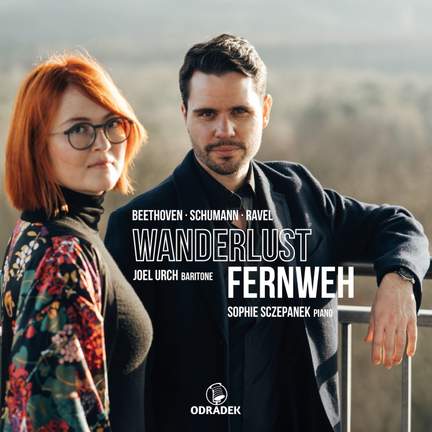
Baritone Joel Urch and pianist Sophie Sczepanek perform an intimate recital of songs by Beethoven, Robert Schumann and Ravel. Alongside the well-known concept of 'Wanderlust' - the purposeful desire for travel - they explore the less widespread expression 'Fernweh': a wistful longing for faraway places that cannot be reached.
In April 1816 Beethoven embarked on his only true song cycle, and the first significant example of the form:An die ferne Geliebte ('To the Distant Beloved'), Op. 98. The German texts were contemporary, written by Alois Jeitteles in 1815; Jeitteles was part of an artistic group that called itself 'Ludlamshohle', whose musical members included Beethoven's teacher Salieri. Jeitteles's texts are full of yearning and in setting these poems Beethoven may have had in mind the mysterious "Immortal Beloved" who would be the subject of his famous unsent love letter a few years later. The cycle combines the artless melodies that epitomise Goethe's notion of the Volksweise (folk tune) with a through-composed structure that links the songs together and integrates the whole cycle.
Influenced by Beethoven's precedent, Robert Schumann composed his song cycle Liederkreis, Op. 39 in 1840, the year in which he married pianist and composer Clara Wieck. The set consists of 12 songs to poetry selected by Clara from Joseph von Eichendorff's collection, Intermezzo; many of the themes that run through these poems echo those of Beethoven's Op. 98. Schumann finished the cycle within three weeks and wrote to Clara that it was his "most profoundly Romantic" work to date, explaining that this outpouring of music seemed unstoppable: "... I can't do otherwise; I want to sing myself to death, like a nightingale."
Don Quichotte a Dulcinee (Don Quixote to Dulcinea) was Ravel's last complete composition. In the 'Chanson romanesque' ('Romantic Song'), seductive but with a hint of pathos, Don Quixote declares his love for Dulcinea. The 'Chanson epique' ('Epic Song') might have its origins in the Basque 'zortziko' style, although its hymn-like characteristics suggest something more prayerful, while the 'Chanson a boire' ('Drinking Song') is based on the 'jota' style from Aragon, its slurring vocal line and the piano's cross-rhythms and bitonality conveying bleary-eyed merriment.
Contents and tracklist
- Sophie Sczepanek, Joel Urch (baritone)
- Sophie Sczepanek, Joel Urch (baritone)
- Sophie Sczepanek, Joel Urch (baritone)