Special offer. Hungarian Heights
Franziska Pietsch, Maki Hayashida, Hila Karni
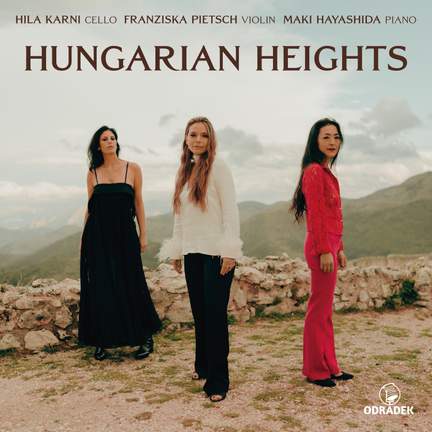
There’s a variety of moods, too, from the fleetfootedness of the Dohnányi finale to the world-weary trudge of the Liszt, all very deftly handled by players who are clearly at ease in each other’s...
Special offer. Hungarian Heights
Franziska Pietsch, Maki Hayashida, Hila Karni
Purchase product
There’s a variety of moods, too, from the fleetfootedness of the Dohnányi finale to the world-weary trudge of the Liszt, all very deftly handled by players who are clearly at ease in each other’s...
About
Following the widespread critical success of their Odradek album Bartok: The Quiet Revolutionary, violist Franziska Pietsch - winner of an ICMA (International Classical Musical Award) in the Chamber Music category - and pianist Maki Hayashida, return with Hungarian Heights: music by Dohnanyi, Kodaly and Liszt, for which they are joined by cellist Hila Karni.
Dohnanyi was profoundly influenced by Liszt and Brahms (who frequently drew upon Hungarian styles), and nowhere is this more evident than in his most significant chamber work, his Violin Sonata in C-sharp minor, Op. 21. Composed in Berlin in 1911, the work's lean structures demonstrate how closely Dohnanyi had been studying Brahms's sonatas, and show Liszt's influence in their thematic integration. Yet this deep level of organisation is delivered with a lightness of touch: an energetic, animated spirit possesses the entire sonata.
Kodaly wrote his Duo for violin and cello, Op. 7 just as the First World War was beginning. The pairing of these instruments is surprisingly rare; few composers have attempted combining these sonorities without a piano or other strings to add textural weight. For Kodaly, the combination inspired an inventive approach to both instruments, resulting in music that is both virtuosic and ingenious.
Liszt channelled his nationality in many ways, but he was also widely travelled, as reflected in his three-volume collection of piano pieces, the Annees de pelerinage (Years of Pilgrimage). The first volume, 'Premiere annee: Suisse' includes the enchanting piece 'Vallee d'Obermann' ('Obermann's Valley'), a title borrowed from the epistolary novel by Etienne Pivert de Senancour. We hear a magnificent version for piano trio; as Pietsch says in the album booklet: "We are immersed in a dark, sonorous meditation on the abysses of the human soul..."
Contents and tracklist
- Franziska Pietsch, Maki Hayashida, Hila Karni
- Franziska Pietsch, Maki Hayashida, Hila Karni
- Franziska Pietsch, Maki Hayashida, Hila Karni
Awards and reviews
 February 2024
There’s a variety of moods, too, from the fleetfootedness of the Dohnányi finale to the world-weary trudge of the Liszt, all very deftly handled by players who are clearly at ease in each other’s company.