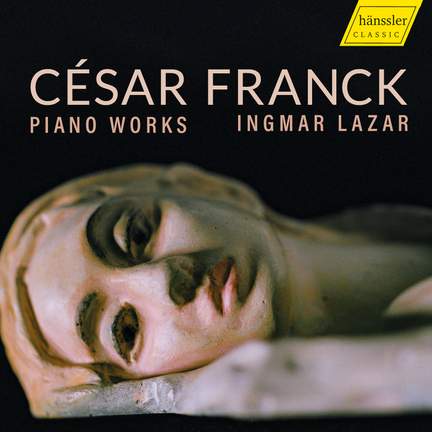
César Franck - Piano Works
Ingmar Lazar (piano)
[The Caprice's] final movement receives an exciting performance from Lazar. He also delivers airy textures in the first two movements of the Prélude, Choral et Fugue, another late work, before...
César Franck - Piano Works
Ingmar Lazar (piano)
Purchase product
[The Caprice's] final movement receives an exciting performance from Lazar. He also delivers airy textures in the first two movements of the Prélude, Choral et Fugue, another late work, before...
About
In February 1835, the young Cesar Franck gave his first public performance as a pianist in his home town of Liege. At that time, he was still a student at the Ecole royale de musique, which he had first entered in 1827. Fol lowing more successful performances in the same year, he completed his studies in Liege and went with his father to Paris to receive further training from Anton Reicha, Pierre Zimmerman and Hippolyte Colet. At the end of the year, father and son returned home to plan Cesar's future career from there on. During this time, Cesar composed the three-movement Piano Sonata (op. 10), which is still very much in the spirit of the classical period and clearly borrows from his role models, but this is to be expected from a 13-year-old boy. Cesar broke away from the formal stylistic idiom of the classical period after leaving the Paris Conservatoire in 1842. His father pushed him toward a career path as a virtuoso, and the son complied, composing his own pieces for this purpose, following in the tradition of piano works by Franz Liszt, Frederic Chopin and Johann Nepomuk Hummel.
Contents and tracklist
- Ingmar Lazar (piano)
- Ingmar Lazar (piano)
- Ingmar Lazar (piano)
- Ingmar Lazar (piano)
Awards and reviews
 November 2023
[The Caprice's] final movement receives an exciting performance from Lazar. He also delivers airy textures in the first two movements of the Prélude, Choral et Fugue, another late work, before bringing his programme to an imposing close