Thomas Simaku: Solo
Jérôme Comte, Dimitri Vassilakis, Aurélien Gignoux, Clément Saunier
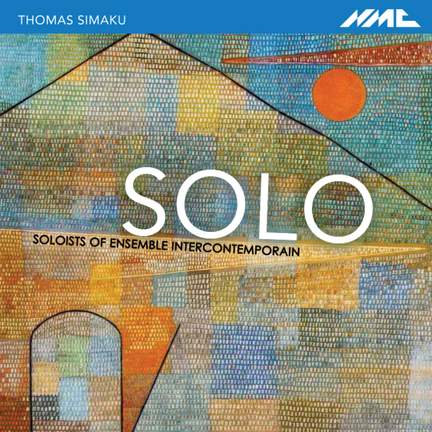
These works from the last four years are played by their dedicatees, who completely inhabit the music, technically and musically.
Thomas Simaku: Solo
Jérôme Comte, Dimitri Vassilakis, Aurélien Gignoux, Clément Saunier
Purchase product
These works from the last four years are played by their dedicatees, who completely inhabit the music, technically and musically.
About
Since Thomas Simaku (b.1958) began composing his cycle of Soliloquys in 1998, the series has grown to encompass every instrumental family of the orchestra. The objective of these works is to delve into and examine the expressive and technical characteristics of each instrument, producing highly virtuosic, idiosynchratic music.
Solo, Simaku's fourth full-length album and first album release on NMC, showcases some of the composer's most recent solo works, each one reaching a depth of expression beyond what seems possible with a single instrument. Simaku's music has been praised for its 'depth of expression, and powerful imagination' (British Composer Award), and his unique blend of lyricism and complex modernity can be traced back to a pivotal moment in the composer's life; when he moved from the restrictive, highly-censored Stalinist Albania of his upbringing, to the UK in 1991. His studies with David Blake at the University of York (where he is now a Professor of Composition himself) were an awakening for the composer, as he was immersed in the music of modernist pioneers such as Ligeti, Kurtag, and Boulez. In the years since, Simaku's free exploration of these ideas has led him to carving out a 'breathtakingly original' compositional voice (Neue Zeitschrift fur Musik), which has won him numerous prestigious awards, including the the first prize in the International Competition for Lutoslwaski's 100th Birthday in 2013. Which better musicians to explore every corner of their instrument's potentialities than the soloists of Ensemble intercontemporain? Founded in 1976 by Pierre Boulez with the support of Nicholas Snowman and Michel Guy, the musicians of the resident ensemble at the Philharmonie de Paris are some of the most highly-regarded soloists in the world. The opening track, Soliloquy VII for clarinet and resonant piano, hears the piece's dedicatee, clarinetist Jerome Comte, displaying the unparalleled versatility and dynamic range of his instrument, the 'vocal' qualities of its sound enhanced by the resonant chamber of the piano into which he plays. Catena II, performed by pianist Dimitri Vassilakis, is a journey into the spiralling colours, gestures and dynamics possible on the piano, in six distinct movements that Simaku conceptualises of as a 'chain'. Percussionist Aurelien Gignoux brings to life Soliloquy VIII for marimba plus, in which Simaku aimed to 'treat the marimba as if it were an orchestra with a huge range of colours and a number of individual lines constantly interacting with one another.' In his composition of the delicate muted sections, menacing pitch bending, and bell-like resonances of Soliloquy IX for trumpet and resonant piano, Simaku conceived of the trumpet as part of a 'resonating canvas', brought to life by soloist Clement Saunier. The album is concluded by Catena III - Corona, Simaku's personal reflection on the devastating effect of the Covid-19 pandemic, heard here in tumultuous syncopated figures and gloomy, lyrical moments.
Contents and tracklist
- Jérôme Comte
- Aurélien Gignoux
- Clément Saunier
Awards and reviews
 November 2023
These works from the last four years are played by their dedicatees, who completely inhabit the music, technically and musically.