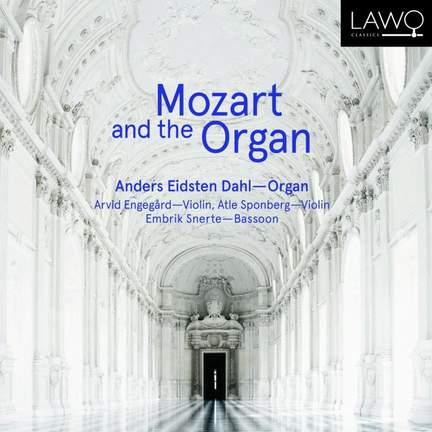
Special offer. Mozart and the Organ
Anders Eidsten Dahl, Arvid Engegård, Atle Sponberg, Embrik Snerte
[The F minor Fantasia, K608] is the highlight of this album: its swirling turns lead to a Baroque fugue which, after a quiet central interlude here on transparent flute, returns with a thrilling...
Special offer. Mozart and the Organ
Anders Eidsten Dahl, Arvid Engegård, Atle Sponberg, Embrik Snerte
Purchase product
[The F minor Fantasia, K608] is the highlight of this album: its swirling turns lead to a Baroque fugue which, after a quiet central interlude here on transparent flute, returns with a thrilling...
About
In a letter to his father Leopold, Wolfgang Amadeus Mozart wrote of his relationship to the organ: "In my eyes and ears, the organ is the queen of instruments."
In spite of his enthusiasm for the instrument and the fact that Mozart himself liked to play the organ, he did not compose much music for "the queen of instruments". The organists of the day improvised when they played for mass, and the organ at that time was not a concert instrument in need of a wide-ranging repertoire.
Mozart's original music for organ consists of 17 one-movement "Epistle sonatas" -- chamber music written between 1772 and 1780 for masses in Salzburg. The instrumentation for 14 of these is two violins and basso continuo, while the remaining three are written for more instruments. The pieces are short -- this is music written to be played between the reading of texts. The organ is given an ever greater concertizing role from the first to the last, and the Sonata in C (K336) can be described as a small organ concerto.
In 1790 Mozart was commissioned to write music for what was known as a "Flotenuhr" -- a large grandfather clock containing a self-playing organ. The instrument was popular at the time -- there are also compositions for the instrument written by Handel, C.P.E. Bach and Haydn. Often the music was meant to describe an event or situation -- the music Mozart was commissioned to write was to be played in a wax museum in memory of Field Marshal Laudon. Mozart was not especially fond of the "Flotenuhr" as an instrument, yet the works are compositions of exceptionally high musical quality. Here the mature Mozart reveals his gifts as a contrapuntalist and his ability to create singable melodies and forward-looking harmonies. The pieces are virtuosic and to some extent must be arranged if they are to be played by someone performing them on the organ.
In addition to organist Anders Eidsten Dahl, the musicians playing on the 14 Church Sonatas are violinists Arvid Engegard and Atle Sponberg and bassoonist Embrik Snerte. Mozart's work for "Flotenuhr" was recorded in St. Margaret's Church in Oslo on an organ clearly inspired by southern German baroque organs.
Contents and tracklist
- Anders Eidsten Dahl, Arvid Engegård, Atle Sponberg, Embrik Snerte
- Anders Eidsten Dahl, Arvid Engegård, Atle Sponberg, Embrik Snerte
- Anders Eidsten Dahl, Arvid Engegård, Atle Sponberg, Embrik Snerte
- Anders Eidsten Dahl, Arvid Engegård, Atle Sponberg, Embrik Snerte
- Anders Eidsten Dahl, Arvid Engegård, Atle Sponberg, Embrik Snerte
- Anders Eidsten Dahl, Arvid Engegård, Atle Sponberg, Embrik Snerte
- Anders Eidsten Dahl, Arvid Engegård, Atle Sponberg, Embrik Snerte
- Anders Eidsten Dahl, Arvid Engegård, Atle Sponberg, Embrik Snerte
- Anders Eidsten Dahl, Arvid Engegård, Atle Sponberg, Embrik Snerte
- Anders Eidsten Dahl, Arvid Engegård, Atle Sponberg, Embrik Snerte
- Anders Eidsten Dahl, Arvid Engegård, Atle Sponberg, Embrik Snerte
- Anders Eidsten Dahl, Arvid Engegård, Atle Sponberg, Embrik Snerte
- Anders Eidsten Dahl, Arvid Engegård, Atle Sponberg, Embrik Snerte
- Anders Eidsten Dahl, Arvid Engegård, Atle Sponberg, Embrik Snerte
- Anders Eidsten Dahl
- Anders Eidsten Dahl
- Anders Eidsten Dahl
Awards and reviews
 December 2023
[The F minor Fantasia, K608] is the highlight of this album: its swirling turns lead to a Baroque fugue which, after a quiet central interlude here on transparent flute, returns with a thrilling counter-subject. While Dahl does not have the throwaway exuberant virtuosity of Simon Preston, the crisp and reedy sound of his instrument is compelling.
 Mar/Apr 2024
The performances of these 14 church sonatas are delightfully energetic and spirited, and the recorded sound is clear and airy.