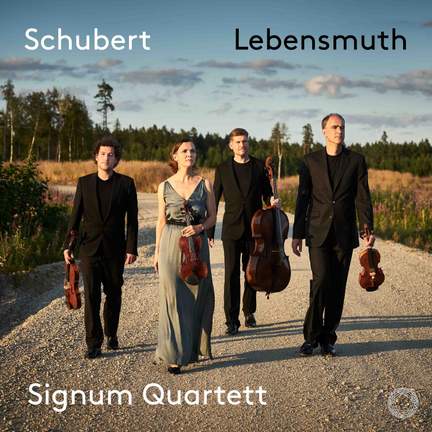
Special offer. Lebensmuth
Signum Quartett (chamber ensemble)
Awards:
-
Opus Klassik Awards, 2024, Winner - Chamber Music Recording of the Year

The real value of this release lies in the fine performance of Schubert’s last string quartet...The Signum Quartett ’s attention to detail is meticulous throughout their performance, and the...
Special offer. Lebensmuth
Signum Quartett (chamber ensemble)
Purchase product
Awards:
-
Opus Klassik Awards, 2024, Winner - Chamber Music Recording of the Year
The real value of this release lies in the fine performance of Schubert’s last string quartet...The Signum Quartett ’s attention to detail is meticulous throughout their performance, and the...
About
Lebensmuth is the final episode of Signum Quartett’s acclaimed Schubert trilogy, in which early and late string quartets are combined with song arrangements created by the group’s violist Xandi van Dijk. Schubert’s First String Quartet in G Minor, written when he was 13, already reveals his inclination to bold and unexpected moves. His last String Quartet in G major, D. 887 veers between a profound examination of personal trauma and a blazing triumph over adversity, and it is this resilience of spirit which is further highlighted by songs such as ‘An die Musik’ and ‘Lebensmuth’, pieces that courageously embrace life and all the beauty it offers. The Signum Quartett is frequently hailed as one of the most adventurous and outstanding ensembles of today. The quartet’s first Pentatone recording Aus der Ferne (2018) won an Opus Klassik 2019 award, as well as a diapason d’or, and was followed by Ins stille Land (2020).
Contents and tracklist
Spotlight on this release
-
An error occurred.
Try watching this video on www.youtube.com, or enable JavaScript if it is disabled in your browser.
Awards and reviews
-
Opus Klassik Awards2024Winner - Chamber Music Recording of the Year
 September 2023
The real value of this release lies in the fine performance of Schubert’s last string quartet...The Signum Quartett ’s attention to detail is meticulous throughout their performance, and the players convey the manic force of the slow movement’s visionary middle section with particular intensity.