Musica Warmiensis Vol. 2
Ingrida Gapova (soprano), Piotr Olech (counter-tenor), Aleksander Rewinski (tenor), Piotr Pieron (bass), Cappella Warmiensis Restituta
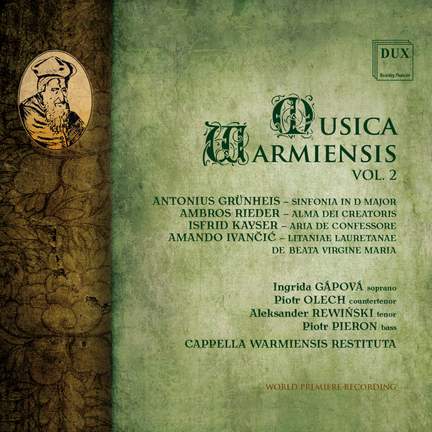
Musica Warmiensis Vol. 2
Ingrida Gapova (soprano), Piotr Olech (counter-tenor), Aleksander Rewinski (tenor), Piotr Pieron (bass), Cappella Warmiensis Restituta
Purchase product
About
This new release from DUX presents world premiere recordings of pieces of Polish sacred music from the late 18th and early 19th centuruies. Musica Warmiensis Vol. 2, is a continuation of a project, founded by the director of the Warmia Metropolitan Seminary "Hosianum" in Olsztyn, Rev. Dr. Tomasz Garwolinski.
This series of releases unearths from the depths of history works of sacred music from the second half of the 18th and the first half of the 19th centuries, once performed by church bands existing in Warmia.
Performers on this recording: Ingrida Gapova; Piotr Olech; Aleksander Rewinski; Piotr Pieron; Cappella Warmiensis Restituta
The works are mostly vocal-instrumental compositions of a sacred character: arias, vespers, litanies, offertories, graduals, masses, but also symphonies and others, mostly dedicated to the band of Dobre Miasto.
The record is crowned by the Litaniae Lauretanae de Beata Virgine Maria [Litany of Loretto to the Blessed Virgin Mary] by Amando Ivancic (1727?1758). Ivancic belonged to the Pauline order, active in Austria. He composed for the Cistercians and the Paulines, as well as for other orders. He wrote mainly works on religious themes and for performance during liturgies and services.
Antonius Grunhei[s]'s Symphony in D Major, is not a typically religious composition, but a secular, rather cheerful one. It consists of three movements, with a solo part for flute within the second movement.
The composer of Alma Dei Creatoris is Ambros Rieder, who lived between 1771 and 1855. His oeuvre is extensive: he wrote religious works (masses, requiems, vespers, cantata compositions), but also compositions for organ (fugues, preludes) and string quartets.
Aria de confessore consists of two movements: Amavit eum Dominus and Et ad portas. It was composed by the Norbertine monk Isfrid Kayser. The first movement is performed by the tenor, while the second movement is performed by all soloists.
Contents and tracklist
- Mikołaj Zgółka (director)
- Cappella Warmiensis Restituta
- Ingrida Gápová, Aleksander Rewiński, Piotr Olech, Piotr Pieron, Mikołaj Zgółka (director)
- Cappella Warmiensis Restituta
- Piotr Olech, Mikołaj Zgółka (director), Ingrida Gápová, Aleksander Rewiński, Piotr Pieron
- Cappella Warmiensis Restituta
- Ingrida Gápová, Aleksander Rewiński, Piotr Olech, Piotr Pieron, Mikołaj Zgółka (director)
- Cappella Warmiensis Restituta