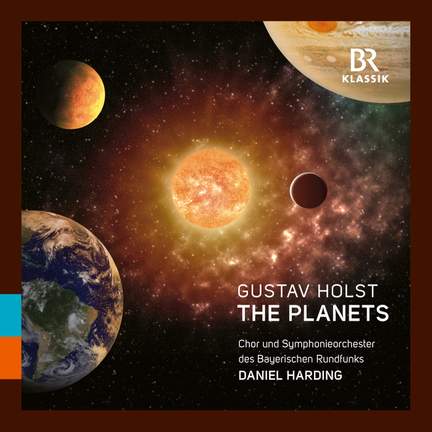
Special offer. Holst: The Planets
Frauenchor Des Bayerischen Rundfunks, Symphonieorchester Des Bayerischen Rundfunks, Daniel Harding
Awards:
-
International Classical Music Awards, 2024, Nominated - Symphonic Music

It's thrilling stuff, all tightly marshalled by Harding, though at times that control holds back the work ’s surging energ y. But it’s a small criticism
Special offer. Holst: The Planets
Frauenchor Des Bayerischen Rundfunks, Symphonieorchester Des Bayerischen Rundfunks, Daniel Harding
Purchase product
Awards:
-
International Classical Music Awards, 2024, Nominated - Symphonic Music
It's thrilling stuff, all tightly marshalled by Harding, though at times that control holds back the work ’s surging energ y. But it’s a small criticism
About
"Seven musical character images – each one immensely sensual and expressive, and standing on its own like a monument. The British composer Gustav Holst, fascinated by (esoteric) astrology, chose the planets of our solar system and the characteristics attributed to them as the basis for what he referred to as musical ""mood pictures"" or ""embodiments"". Ultimately, the seven movements of his orchestral suite “The Planets”, op. 32, composed between 1914 and 1916, can also be understood as general explorations of human traits. The work had not been performed by the Bavarian Radio Symphony Orchestra for almost three decades when, on February 25, 2022, the British conductor Daniel Harding brought it back to Munich’s concert audience in the Herkulessaal of the Residenz, and with great success. During a trip to Mallorca in the summer of 1913, Holst’s friend Clifford Bax introduced him to astrology for the first time and the composer immediately began to draw up horoscopes for himself and his acquaintances. The extent to which he actually believed in the influence of celestial bodies on personality formation played only a subordinate role here; it was the notion of a holistic system that could encompass both man and the world that fascinated him the most. His interest in astrology also offered him a welcome break from the monotony of his life as a teacher – at St. Paul's School for Girls and at Morley College, where he taught working-class adults.
A first (private) performance of the orchestral suite took place on September 29, 1918 at the Queen's Hall in London, with Adrian Boult conducting. Public performances of individual movements followed. A few months before the first public performance of the complete work, presented by Albert Coates and the London Symphony Orchestra on November 15, 1920, Holst revealed its cosmic subject. Before then, only the initiated knew what lay behind the rather cryptic movement designations. At the premiere it was above all ""Mars, the Bringer of War"" that struck a chord with a nation traumatised by World War One. Remarkably, Holst had already written this first movement of his suite in the summer of 1914, when the countries of Europe were still merely engaged in patriotic sabre-rattling. His clear-sighted portrait of the destructive machinery of war – in the relentlessly repeated 5/4 march rhythm – runs counter to the positivist characterisation of ""Mars the Warrior"" in conventional astrology."
Contents and tracklist
Awards and reviews
-
International Classical Music Awards2024Nominated - Symphonic Music
 July 2023
It's thrilling stuff, all tightly marshalled by Harding, though at times that control holds back the work ’s surging energ y. But it’s a small criticism
 29th April 2023
this is a revelatory performance. Horns and woodwind are expressive, strings lithe, the layers of wordless high voices perfectly blended...The British conductor, heard more abroad than at home, is a force to reckon with. If you thought you knew this most popular work inside out, give the Bavarians’ account a listen.