Poulenc: Piano Works
John Damgaard (piano)
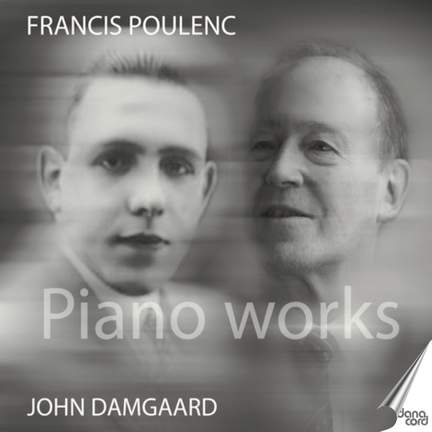
Poulenc: Piano Works
John Damgaard (piano)
Purchase product
About
As a young student I had the pleasure to play Francis Poulenc’s Sextet for Nadia Boulanger. Feeling uneasy with some of the more or less banal themes I asked for her help. She said that Poulenc had a strong sense of humor, but always expressed it in an extremely serious way – which made it even more humorous. And you had to treat his music in the same manner. Always serious. Poulenc’s musical life was at a time, where the tonal system more or less had outlived itself. The 12-tone music had taken over. At least in the Germanic musical world. But Poulenc detested this form of intellectual way of making music. Music had to be conceived through the ear. In 1943, when he wrote his Intermezzo in A-flat major, he ended the piece with 12 chords in all the keys...probably an ironic greeting to the Germans in Paris! Already in 1928, he showed - in one of his most beautiful pieces - the Pastorale - that it is possible through the ear to make beautiful chords containing almost all the 12 different notes at the same time. Beautiful sonority has always been a major key to French Music. Many years later Pierre Boulez said “I wish I could compose in major/minor keys. But I can’t!” Another of his beautiful pieces the Mélancolie is written in August 1940 – 3 months after the Germans went into Paris. Leonard Bernstein suggested in one of his Harvard Lectures that the interval of a downward third is an arche-type. In all cultures that means “mother”! Mélancolie ends with a downward third 3 times – a definite cry for help. With these elements in consideration, it is totally wrong to judge Poulenc a light weight French composer – which has often been the case. He is much more an original, serious French composer with a lot of humor.