Special offer. Sammartini: Sonatas For Cello & B.c.
Ensemble Dolci Accenti (performer)
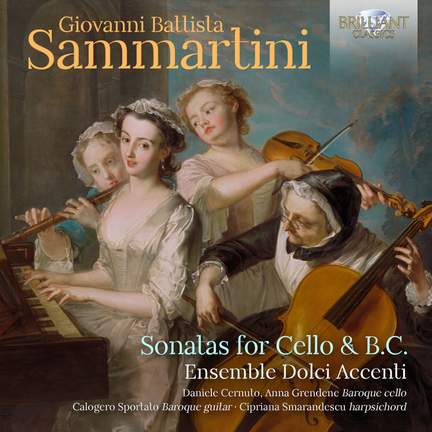
Special offer. Sammartini: Sonatas For Cello & B.c.
Ensemble Dolci Accenti (performer)
Purchase product
About
The essential contribution that Milan-born Giovanni Battista Sammartini (c.1700–1775) made to the history of music is universally recognised. He laid the foundations for the Classical symphony: he helped establish the standard composition of the orchestra and promoted independence and individual timbres in his part-writing, while Baroque customs (most notably the basso continuo) gradually gave way to sonata form. In terms of repertoire and recordings, however, Sammartini is still a relative rarity; if you set aside his symphonies and start investigating his chamber music and works for solo instruments, for example, it is soon apparent that many enthralling compositions remain silently filed away in libraries and archives, waiting patiently for the recognition they deserve.
The programme on this record ventures into this very partially unexplored terrain, showcasing a selection of sonatas for cello and basso continuo: the collection of six from his Op.4, published in Paris in 1742, and two sonatas of uncertain date, one in G major and the other in G minor. Although more modest than the symphonies, the cello sonatas display a similar penchant for succinct and elegant writing. Often simple in form, their brilliance stems from the inventiveness of the melody and rhythm and moments of particularly intense and expressive lyricism that are not reliant on excessive ornamentation. Christoph Willibald Gluck, according to some sources, studied under Sammartini: there are plenty of moments in the cello sonatas where echoes of what must have inspired the German master can be heard. When Franz Joseph Haydn was alive, he was also considered to owe a great deal to Sammartini; this seems to have struck a nerve, as he felt the need to distance himself from these claims, even calling his Italian colleague a ‘pencil pusher’.
However, it is important to note the confusing history behind the authorship of the cello sonatas on this album. Op.4 is almost certainly by Sammartini; the ‘almost’ is advisable only for Sonata No.6, which some scholars believe to be of doubtful authorship. The two sonatas in G major and G minor are less certain. Despite these caveats, the cello sonatas presented here remain an excellent example of the transition from the Baroque to the Classical period and particularly of a singularly elegant compositional style that expertly applies cello technique to imaginative and spontaneous invention. Partly for this reason, the performers on this recording have chosen to further enhance the individual character and freshness of each sonata by using different instruments for the basso continuo line, chosen freely but with strong historical foundations: as well as the more predictable harpsichord, they also make use of the archlute, theorbo and baroque guitar, in addition to melodic bass passages entrusted to a second cello. Overall, the seductive balance of formal precision and improvisatory spirit seen in Sammartini’s better-known works is still clearly perceptible here; presenting the less easily identifiable works on this discographic rarity in his name therefore certainly does not do him a disservice.
Giovanni Battista Sammartini (1701-75) was born in Milan, and unlike his contemporaries, spent all his life working in his home city. He became the major figure in musical life in the city, and devoted himself to instrumental, chamber and sacred music, composing only three stage works, making him one of those rare Italian composers who shunned the world of opera. His works were widely published in all the major cities of Europe, and he was on friendly terms with Gluck whom he taught from 1737-41, and Mozart whom he met during the young Austrian’s visit to Milan. His influence upon composers such as François-Joseph Gossec, Johann Christian Bach and Johann Stamitz was considerable.
The Cello Sonatas presented here mark the transition between Baroque and Classicism, music full of charm, gracefulness, cantabile melodies and instrumental flourish. Played by the Italian ensemble Dolci Accenti, with Daniele Cernuto (Baroque cello), Calogero Sportato (Baroque guitar, theorbo, archlute), Cipriana Smarandescu (harpsichord) and Anna Grendene (Baroque cello).
Recorded July 2020 in Sardinia.
Booklet in English contains liner notes by Marco Bellano, and a profile on the ensemble.
Contents and tracklist
- Ensemble Dolci Accenti
- Ensemble Dolci Accenti
- Ensemble Dolci Accenti
- Ensemble Dolci Accenti
- Ensemble Dolci Accenti
- Ensemble Dolci Accenti
- Ensemble Dolci Accenti
- Ensemble Dolci Accenti