Beethoven, Bach & Brahms: Piano Works
Georg Kjurdian (piano)
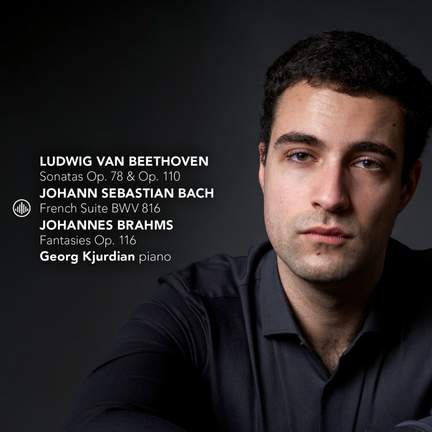
Beethoven, Bach & Brahms: Piano Works
Georg Kjurdian (piano)
Purchase product
About
The debut album from Latvian pianist Georg Kjurdian. "Bach, Beethoven and Brahms: the composers often referred to in the German-speaking world as "the three great B's". The figures who have accompanied me my whole life long. Forming, so to speak, the two "outer edges" of the CD are Beethoven's Sonatas op. 78 and op. 110. The two-movement sonata op. 78 is the very first work of Beethoven's that I ever studied and rehearsed, back when I was still a pupil at my high school, specializing in music, in Riga. Today, after more than ten years have gone by, Beethoven's op. 78 seems to me to be an even more extreme work than it did back then. It is unusually short for a sonata, with a lyrical first movement and a whimsical second one, the humorousness of which comes close to exceeding the limits of propriety. Beethoven's op. 110 is a work of a completely opposite nature to this. One is confronted, in its four movements, respectively with four different worlds: a lyrical-operatic world in the first; a coarse, rumbustious one in the second; a despairingly tragic one in the third; and finally a reconciled world in the fourth. Bach's little Prelude in C Major was the piece which really prompted my definite decision to become a pianist by profession. His French Suite no. 5 in G Major (BWV 816) is one of Bach's most vivacious and optimistic-sounding compositions. Considered from our present-day viewpoint, the Suite represents a sort of musical tour through Europe. At the end of this Suite the listener has the feeling that he has spent a brief holiday respectively in each of several European countries, having gotten a sense and taste of the various temperaments, scents and rhythms of each. By the age of 16 Brahms had become one of my greatest favourites. I had such reverence for him that for several years I did not even dare to learn his pieces or to play them. I began to do this only at age 22. The 7 Fantasies (op. 116) which I present on the CD was composed in 1892. This means that it counts among those late works of Brahms in which he paid much more attention to working in smaller forms but also to achieving, in these forms, an extremely intimate and intensive form of self-expression. The cycle in question here consists of 3 capriccios and 4 intermezzi. The capriccios produce a virtuosic and extroverted impression; the intermezzi, by contract, an impression of extreme lyricism and melancholy. In the case of Op. 116 it is the 4 intermezzi, with their enormous inner strength and melancholy air, that build up the emotional core of the cycle." - Georg Kjurdian
Contents and tracklist
- Georg Kjurdian (piano)
- Georg Kjurdian (piano)
- Georg Kjurdian (piano)
- Georg Kjurdian (piano)