Luciuk: Antiphonae - Apocalypsis
THE “COLLEGIUM CANTORUM” CHOIR OF THE CZĘSTOCHOWA PHILHARMONIC, Agata WIDERA-BURDA, Weronika GĘBALA, Grzegorz Rogut, Michał Gębala, The “collegium Cantorum” Choir Of The Częstochowa Philharmonic, Janusz Siadlak
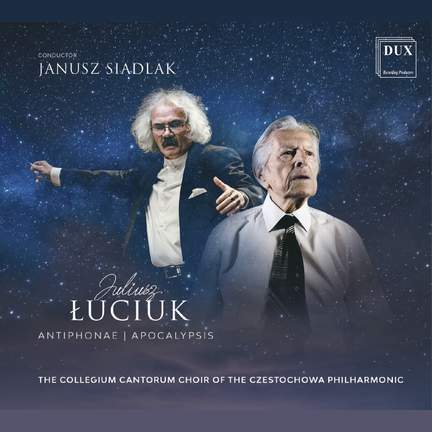
Luciuk: Antiphonae - Apocalypsis
THE “COLLEGIUM CANTORUM” CHOIR OF THE CZĘSTOCHOWA PHILHARMONIC, Agata WIDERA-BURDA, Weronika GĘBALA, Grzegorz Rogut, Michał Gębala, The “collegium Cantorum” Choir Of The Częstochowa Philharmonic, Janusz Siadlak
Purchase product
About
The core of Juliusz Luciuk's musical oeuvre are religious vocal and instrumental works, piano compositions, and great stage works. Luciuk composed for a continuous period of over sixty years; from neoclassicism, through the musical avant-garde, to religious neotonality.
In 1984, Luciuk completed the Quattro Antiphonae to the Blessed Virgin Mary for a cappella male choir, in which each of the four antiphons drew abundantly from the tradition of European religious music related to the Gregorian chant. The four Antiphonae, though at first give the impression of arrangements of choral melodies, are not actually arrangements, and their course is only partially predictable for the listener in terms of melody and sound.
Within Apocalypsis, transparent types of texture and expressive melodies dominate, and the basic means of expression are tone colour and articulation emphasizing the text. In the joyful finale, in which good ultimately triumphs over evil, the musical narrative is complicated by the syncopated rhythms and quasi-jazz solutions.
In 1985 Partes Variabiles was created. It was a time when the Luciuk was more deeply involved in the sphere of religious spirituality expressed by sounds and contained in neotonal harmonies, a dense but clear texture, rich tone colours, and the sophisticated use of sounds. This work is considered the beginning of his mature work of a religious and national ethos, reflecting the core idea of ennobling the sonic layer and constituting an intimate artistic expression with transcendental contents, characterized by a strong self-stigmatization and love for God.
Musicologist Maciej Negrey wrote: "Luciuk is one of the most outstanding representatives of Polish contemporary vocal music. From the very beginning, his artistic expression was accompanied by the sound of a human voice."
Contents and tracklist
- THE “COLLEGIUM CANTORUM” CHOIR OF THE CZĘSTOCHOWA PHILHARMONIC
- Janusz Siadlak
- THE “COLLEGIUM CANTORUM” CHOIR OF THE CZĘSTOCHOWA PHILHARMONIC
- Janusz Siadlak
- THE “COLLEGIUM CANTORUM” CHOIR OF THE CZĘSTOCHOWA PHILHARMONIC
- Janusz Siadlak
- THE “COLLEGIUM CANTORUM” CHOIR OF THE CZĘSTOCHOWA PHILHARMONIC
- Janusz Siadlak
- Agata WIDERA-BURDA, Weronika GĘBALA, Grzegorz Rogut, Michał Gębala
- The “collegium Cantorum” Choir Of The Częstochowa Philharmonic
- Janusz Siadlak
- THE “COLLEGIUM CANTORUM” CHOIR OF THE CZĘSTOCHOWA PHILHARMONIC
- Janusz Siadlak
- THE “COLLEGIUM CANTORUM” CHOIR OF THE CZĘSTOCHOWA PHILHARMONIC
- Janusz Siadlak
- THE “COLLEGIUM CANTORUM” CHOIR OF THE CZĘSTOCHOWA PHILHARMONIC
- Janusz Siadlak
- THE “COLLEGIUM CANTORUM” CHOIR OF THE CZĘSTOCHOWA PHILHARMONIC
- Janusz Siadlak