The Cello At Montecassino Abbey
Matteo Malagoli (cello), Yukiko Shimizu, Ludovica Marcuzzi (soprano), Flavia Del Guidice, Milli Fullin (mezzo-soprano), Alberto Pelosin conductor
Cristina Centa (harp), Lisa De Polo (piano), Alvise Mason (organ/harmonium), Raffaele Giordani (tenor), Hazar Mursitpinar (baritone)
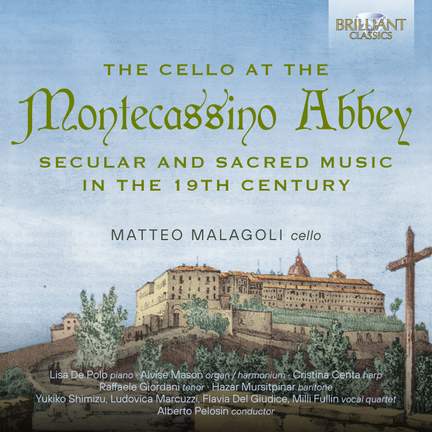
The Cello At Montecassino Abbey
Matteo Malagoli (cello), Yukiko Shimizu, Ludovica Marcuzzi (soprano), Flavia Del Guidice, Milli Fullin (mezzo-soprano), Alberto Pelosin conductor
Cristina Centa (harp), Lisa De Polo (piano), Alvise Mason (organ/harmonium), Raffaele Giordani (tenor), Hazar Mursitpinar (baritone)
Purchase product
About
"Founded in 529 AD by Benedict of Nursia, the abbey is still considered the ancestral monastery of the Benedictine Order. In 744 the archabbey was granted independence; it ended in 1503 when the territorial abbey fell to the Kingdom of Naples or, from 1860, to the Kingdom of Sardinia. Since 1927 Montecassino Abbey has been part of the then newly formed province of Frosinone (Lazio). The abbey also gained sad notoriety during the Second World War, when it was completely destroyed in the Battle of Montecassino. From 1948 to 1956 the abbey was rebuilt according to the original plans".
The instruments often used were piano, harmonium, flute, violin and cello. The cello however was the most important instrument, which is confirmed by the important solo cello scores and Methods stored in the local Archive, proof of the strong affection to this instrument.
The cello literature includes both sacred and secular works. Sacred works came only from the 19th Century but secular music originated from the 17th century (Rocco Greco and Gaetano Francone) till the late 19th Century Neapolitan era. The preservation of the Archive was in the hands of Padre Mauro Liberatore from L’Aquila (1810-1879), cellist, flutist and music arranger and Padre Placido Abela from Syracuse (1814-1876), organist, pianist and composer.
This fascinating set features cello music by Bertoja, Mercadante, Abela, Coop, Ray, Krug, Thalberg and others. The first CD presents secular chamber music, the second CD presents Sacred works, in instrumental settings.
Played by Matteo Malagoli (cello), Alvise Mason (organ) and Lisa De Polo (piano), and other vocalists and instrumentalists.
Contents and tracklist
- Matteo Malagoli, Alan Dario
- Matteo Malagoli, Lisa De Polo
- Matteo Malagoli, Alvise Mason, Lisa De Polo
- Matteo Malagoli, Cristina Centa
- Lisa De Polo, Alvise Mason, Matteo Malagoli
- Hazar Mursitpinar, Matteo Malagoli, Lisa De Polo
- Matteo Malagoli, Lisa De Polo
- Matteo Malagoli, Lisa De Polo
- Matteo Malagoli, Lisa De Polo
- Matteo Malagoli, Lisa De Polo
- Yukiko Shimizu, Ludovica Marcuzzi, Milli Fullin, Alvise Mason
- Yukiko Shimizu, Ludovica Marcuzzi, Milli Fullin, Flavia Del Giudice, Matteo Malagoli, Alvise Mason
- Yukiko Shimizu, Ludovica Marcuzzi, Milli Fullin, Flavia Del Giudice, Alvise Mason
- Raffaele Giordani, Matteo Malagoli, Alan Dario, Angelo Liziero, Alvise Mason
- Matteo Malagoli, Lisa De Polo