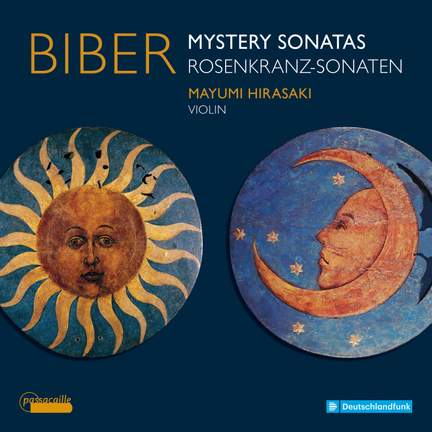
Biber: Mystery Sonatas
Mayumi Hirasaki (violin), Michael Freimuth, Christine Schornsheim (early keyboard instruments), Johannes Loescher, Jan Freiheit
Hirasaki darts across her instrument with gravitydefying lightness, her bow seeming to barely graze the strings. Yet her tone resonates wonderfully, and she also achieves a serenity and grace...
Biber: Mystery Sonatas
Mayumi Hirasaki (violin), Michael Freimuth, Christine Schornsheim (early keyboard instruments), Johannes Loescher, Jan Freiheit
Purchase product
Hirasaki darts across her instrument with gravitydefying lightness, her bow seeming to barely graze the strings. Yet her tone resonates wonderfully, and she also achieves a serenity and grace...
About
Biber's Rosary Sonatas are without doubt among the most colourful and brilliantly virtuosic works in the entire Baroque violin literature. Their distinctive feature is the scordatura, a tuning of the violin strings individually prescribed for each sonata, which allows a more colourful differentiation of the musical characters.
For her meticulously prepared and well thought-out recording, scordatura specialist Mayumi Hirasaki has assembled a group of renowned specialists and thus presents one of the most remarkable recordings of this cycle, which never ceases to fascinate.
This form of the rosary has been in use in the Roman Catholic church for centuries as a type of Marian Psalter. It gradually became customary to add an attribute to the name of Jesus in the first part of the Hail Mary during the recitation of the rosary, linking it to one of the fifteen canonical mysteries of the Joyful, Sorrowful and Glorious Mysteries that describe the birth and salvation of the Son of God and of his Mother.
The Salzburg court musician Heinrich Ignaz Franz Biber (16441704) composed, according to his preface, fifteen sonatas "to the honour of the fifteen holy mysteries" of the Rosary, dedicating these to his prince-archbishop Max Gandolph von Kuenburg in a manuscript decorated with small medallion-like copperplate engravings. Biber, a native of Bohemia, had gone to visit to the Tyrolean master violin maker Jacobus Stainer to purchase instruments in 1670, but failed to return to his then employer, Karl von Liechtenstein-Kastelkorn, Bishop of Olomouc, who resided in Kremsier. Biber, who had presumably taken advantage of lessons for some time with Johann Heinrich Schmelzer, violinist to the Imperial court in Vienna, apparently preferred to take up a position at the Salzburg court.
The above manuscript, the only known source of the Mystery or Rosary Sonatas the prime reason that Biber is known to today's musicians accords with the structure of the chain of prayers. This cycle of sonatas was most probably known only to the Salzburg prince-archbishop and his chamber musicians during Biber's lifetime.
Contents and tracklist
- Mayumi Hirasaki, Michael Freimuth, Christine Schornsheim, Johannes Loescher
- Mayumi Hirasaki, Michael Freimuth, Christine Schornsheim
- Mayumi Hirasaki, Michael Freimuth, Christine Schornsheim
- Mayumi Hirasaki, Michael Freimuth, Christine Schornsheim
- Mayumi Hirasaki, Michael Freimuth, Christine Schornsheim, Johannes Loescher
- Mayumi Hirasaki, Michael Freimuth, Christine Schornsheim, Jan Freiheit
- Mayumi Hirasaki, Michael Freimuth, Christine Schornsheim, Jan Freiheit
- Mayumi Hirasaki, Michael Freimuth, Christine Schornsheim, Jan Freiheit
- Mayumi Hirasaki, Michael Freimuth, Christine Schornsheim
- Mayumi Hirasaki, Michael Freimuth, Christine Schornsheim, Jan Freiheit
- Mayumi Hirasaki, Michael Freimuth, Christine Schornsheim, Jan Freiheit
- Mayumi Hirasaki, Michael Freimuth, Christine Schornsheim, Johannes Loescher
- Mayumi Hirasaki, Michael Freimuth, Christine Schornsheim, Jan Freiheit
- Mayumi Hirasaki, Michael Freimuth, Christine Schornsheim, Johannes Loescher
- Mayumi Hirasaki, Michael Freimuth, Christine Schornsheim
Awards and reviews
 February 2023
Hirasaki darts across her instrument with gravitydefying lightness, her bow seeming to barely graze the strings. Yet her tone resonates wonderfully, and she also achieves a serenity and grace in keeping with the Sonatas’ spiritual subject matter.