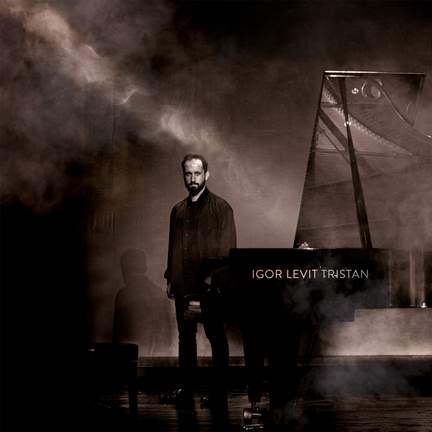
Tristan
Igor Levit (piano), Gewandhausorchester Leipzig, Franz Welser-Möst
Awards:
-
Presto Recording of the Week, 16th September 2022

-
The Guardian Classical Albums of the Year, 2022

-
Opus Klassik Awards, 2023, Nominated - Conductor of the Year

If I had to pick one word to describe this recording, it would be ‘ intense’...An unsentimental, unshowy and rather lovely Liebestraum No. 3 opens proceedings; a cathartic Harmonies du soir...
Tristan
Igor Levit (piano), Gewandhausorchester Leipzig, Franz Welser-Möst
Purchase product
Other available formats

Awards:
-
Presto Recording of the Week, 16th September 2022
-
The Guardian Classical Albums of the Year, 2022
-
Opus Klassik Awards, 2023, Nominated - Conductor of the Year
If I had to pick one word to describe this recording, it would be ‘ intense’...An unsentimental, unshowy and rather lovely Liebestraum No. 3 opens proceedings; a cathartic Harmonies du soir...
About
On Igor Levit’s double album “Tristan” – which will be released on Sony Classical on September 9, 2022 - the pianist explores nocturnal themes of love and death, fear, ecstasy, loneliness & redemption in the music of Richard Wagner, Franz Liszt, Gustav Mahler & Hans Werner Henze. It includes Levit’s first concerto recording with the Gewandhausorchester Leipzig under Franz Welser-Möst with the album’s central work Henze’s “Tristan” for piano, electronic tapes and orchestra.
The five works, including Liszt’s “Liebestraum no. 3” and “Harmonies du Soir”, as well as transcriptions of Wagner’s “Prelude to Tristan und Isolde” and Mahler’s “Adagio from Symphony no. 10”, span a period of 135 years (1837 to 1973) and represent very different genres. Only one of these works was originally conceived for piano solo, but Igor Levit’s exploration of borderline experiences in our lives – death in Life (2018), spirituality in Encounter (2020) and now, with Tristan, the link between love, death and our need for redemption – inevitably means that it is not just masterpieces for the piano that are central to his concern but, above all, compositions in which certain thematic associations find their most personal expression.
Levit’s own thoughts revolve less around the themes of love and death as such than around the experience of night and of the nocturnal as a dark alternative to our conscious actions by day. “Night has so many faces. It can signal a place of refuge or the loss of control, it signifies love and death, and it is the place where we feel our deepest, most paranoid fears,” says Levit. “The Adagio from Mahler’s Tenth Symphony contains a famous outburst of pain in the form of a dissonant chord, and Wagner’s Tristan und Isolde is all about a kind of emotional nuclear meltdown. All of the piece’s essential actions take place at night. In his reminiscences, Hans Werner Henze likewise recalled his work on Tristan as a time of nightmares and of dreamlike hallucinations.”
Hans Werner Henze’s Tristan – described by the composer as a set of “Preludes for piano, tape and orchestra” – is a raptly refined hybrid work comprising passages for solo piano and electronics and is a concerto, a symphony and a piece of music theatre all wrapped into one. The present recording of this work was made during the concerts that were given in Leipzig in November 2019.
Liszt’s nocturne in A♭ major – his Liebestraum no. 3 – derives from a setting of melancholic lines by Ferdinand Freiligrath: “Oh, love as long as you can love! / Oh, love as long as you could crave! / That hour is fast approaching when / You’ll stand and weep beside the grave!”
The same sense of nocturnal despair is also found with Mahler, who in late July 1910 was working on the opening movement of his Tenth Symphony when he discovered that his wife was having an affair. Igor Levit performs this Adagio in a little-known piano transcription by the Scottish composer Ronald Stevenson, whose great Passacaglia on DSCH he has done so much recently to promote.
Only in Harmonies du soir, the eleventh of Liszt’s twelve Études d’exécution transcendante, is there any sense of reconciliation, a peaceful counterweight to the ecstasies and nightmares experienced by those Wagnerian and Mahlerian figures who in Wagner’s own words are “devoted to the night”.
Contents and tracklist
- Arr. for Solo Piano by Zoltán Kocsis
- Igor Levit (piano)
- Arr. for Solo Piano by Ronald Stevenson
- Igor Levit (piano)
Spotlight on this release
-
An error occurred.
Try watching this video on www.youtube.com, or enable JavaScript if it is disabled in your browser.
-
An error occurred.
Try watching this video on www.youtube.com, or enable JavaScript if it is disabled in your browser.
-
An error occurred.
Try watching this video on www.youtube.com, or enable JavaScript if it is disabled in your browser.
-
Igor Levit's Tristan
16th Sep 2022
Hans Werner Henze's brilliant, baffling set of ‘Preludes for piano, electronic tapes and orchestra’ sits at the heart of this Wagner-inspired recital, which also includes music by Liszt and Mahler via Ronald Stevenson.

Awards and reviews
-
Presto Recording of the Week16th September 2022
-
The Guardian Classical Albums of the Year2022
-
Opus Klassik Awards2023Nominated - Conductor of the Year
 November 2022
If I had to pick one word to describe this recording, it would be ‘ intense’...An unsentimental, unshowy and rather lovely Liebestraum No. 3 opens proceedings; a cathartic Harmonies du soir concludes them.
 Awards Issue 2022
Levit takes the opening bars of the Wagner/Kocsis Tristan Prelude about as slowly as they can go without falling apart, but thereafter he does allow enough ebb and flow to build towards an impressive architectural whole.
 16th September 2022
We’re eased in relatively gently with a glowing but unsentimentalised account of Liszt’s evergreen Liebestraum No. 3, where the flowing tempo and cantabile line remind us of the work’s vocal roots...You may well find yourself as baffled as you are beguiled [by Henze's Tristan], but both Levit and the radiant Gewandhausorchester under Franz Welser-Möst prove the most clear-eyed of guides, ensuring that Henze’s many and varied ideas (not to mention the listeners themselves) have the requisite space to breathe.
 17th September 2022
Levit shines light on the dissonant enigma that is the Adagio from Mahler’s 10th symphony, in the transcription by Ronald Stevenson. Liszt’s Transcendental Etude No 11, “Harmonies du soir”, with its rippling, harp-like left hand and song-like right-hand chords, bursts into radiance then subsides to a shadowy, tranquil ending, the disc’s perfect finale.
 7th September 2022
As usual, Levit’s devotion to pursuing particular experiences and states of mind leads him to unusual, if not intransigent, repertoire...It only takes a few moments of Liszt’s Liebestraum No 3 for the pianist’s structural grip and subtleties of phrasing and touch to create magic, also evident in the final track (more Liszt) and the prelude to Wagner’s Tristan und Isolde, the germ from which this panorama springs.